
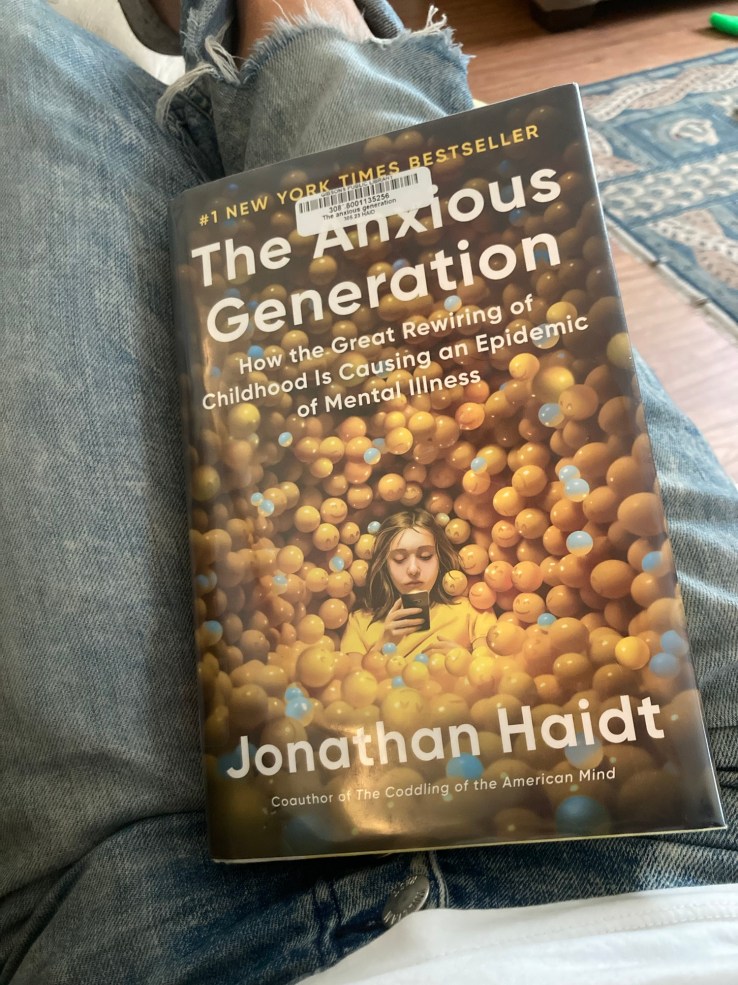
When I posted on Instagram that I was currently reading The Anxious Generation, I very quickly received several DMs from friends that they were curious about the book, that they wanted to read it too, or that they wanted to know what I thought when I had finished. So here’s what I think:
Every parent or educator I know who has read this book or is interested in this book is someone I already know to be thoughtful in their approach to parenting or teaching. I think this is a book that you probably pick up because you are already inclined to agree with its basic premise. If you think phone access for young people today is just fine and don’t have any qualms about your pre-teen getting an Instagram account, you probably won’t care what Haidt has to say about the matter. But if, like many parents, you do wonder and worry about these things, you’ll find a lot to agree with here.
There’s been some question about Haidt’s research, particularly, as I understand, his use of fairly small sample sizes. I haven’t delved into all of that though I did get the sense in certain parts that Haidt was leaning heavily on examples that supported his pre-conceived theories. I can’t speak to the science backing many of his claims but what Haidt really relies on is something many of us already feel. Constant access to internet and social media – something we carry around in our pockets and can even bring to bed with us – isn’t bettering our lives. And it certainly isn’t going to make our children’s lives better.
Haidt’s basic premise is that children today, particularly since about 2010 with the advent of the smart phone are having phone childhoods (he includes tablets and other devices in this) when they should be having play childhoods. Beginning with Generation Z, kids have been spending more time online which actually means they are more disconnected from their peers and therefore are becoming more anxious and depressed. At the same time, with the rise of what Haidt calls “safetyism”, kids are spending less time outdoors and less time in free, unstructured play. Our kids are more monitored in real life than any before but not as monitored online as they should be.
This is bigger than any individual parenting decision and while Haidt does offer some outlines of what might be appropriate times to introduce screens and phones into our homes, he also looks at the social constructs that have led us to this moment in history. It’s all pretty fascinating. I’ve talked about some of this issues before when reviewing books like Small Animals and Last Child in the Woods. I’m a parent with kids just at the cusp of growing independence and I was encouraged to find that a lot of what we already do as parents is in line with Haidt’s suggestions. Kids need freedom to play at the park with their friends. They need to know they can be independent and take responsibility for themselves. Let them walk to school alone. Send them to the grocery store to buy milk, even if you don’t need it.
I found myself nodding along because these are things we’ve started doing in small doses in our family. At the same time, I felt like Haidt wasn’t always well in touch with the realities of allowing these things. I can let my kids walk to school on their own because we live in a small community and we’ve put in the years of walking with them so that they know the route well and are recognized by many in our neighbourhood. To be able to do so is a privilege. Haidt mentions a few times that phone usage is actually much higher among children in single parent families or in lower income areas but he never really addresses how we as a society can change that.
Schools are obviously also a big part of how phone usages can be tackled. My girls attend a school that was one of the first in our district to ban phones in class, a policy that is now province-wide. When that decision was announced I was relieved because my kids are young enough that phones at school aren’t a big issue for them yet and this would, hopefully, buy us a few more years before they became one. As of now, none of my kids’ friends have phones either but that time is probably coming soon.
For me, one of the most interesting sections of Anxious Generation was when Haidt addresses the issue of spiritual elevation and degradation. While he comes at it from an atheist perspective, he makes the argument that certain experiences elevate our inner being – our souls – while others degrade them. Hiking a mountain or lunch with a good friend are elevating experiences. Viewing someone’s instagram story of their hike or brunch doesn’t have the same affect. In fact, Haidt argues, time spent online actually has more of a degrading affect. This is hard to quantify and likely easy to repute but I think many of us also can understand what Haidt is saying. Scrolling endlessly online doesn’t feel good or satisfy us. We may be learning things but we’re not engaging with the world the way that we were meant to. Not to mention that time spent online can mean exposure to horrible things that we as humans aren’t meant to witness. Now imagine what that’s doing to the inner development of our children. It’s an interesting argument and one I haven’t seen made quite in this way before.
As I said, this book probably benefits from a certain bias in the readers most likely to pick it up. But one day, when my kids probably will ask whether or not they can have a phone of their own, I’ll be glad to have a little more thought and research to back up my answer when I tell them, “No”.

 Karissa Reads Books
[…] What is the main premise of Jonathan-Haidt's book 'The-Anxious-Generation'?The main premise of Jonathan-Haidt's book 'The-Anxious-Generation' is that the advent of smartphones and the resulting 'phone-based childhood' have significantly contributed to the epidemic of mental-illness among adolescents, particularly since around 2010. Haidt argues that children are spending more time online, leading to increased disconnection from peers, and less time in free, unstructured play, which is essential for their social and neurological development (The-Anxious-Generation – Karissa Reads Books). […]
I wonder this author to write the book, because there’s already so many documentaries about why phone usage is bad for teens and preteens. We know it causes more depression and anxiety, we know that trafficking minors is on the rise, we know that teens and preteens actually wish that they didn’t feel addicted to their phones, which, to me, is a way of saying help. We also know that the number one way that researchers recommend parents help their children detach from their phones and tablets is to actually serve as good examples. You can’t tell your kids, no phones and then sit there for hours on your own phone. I know that you and Peter are hands-on, outdoors, kind of people, and your children are obviously learning to love that lifestyle and see the value in it too. Even reading before bed together is a big part of avoiding phone addiction.
There are a lot of books and articles and writing about this topic. I think Haidt offers enough new thought and research to make the book worthwhile but it is very much along the lines of things we probably all already know. You’re absolutely right – most parents now didn’t grow up with smart phones but are still way too attached to them (myself included). My kids definitely see me using my phone a lot but I also make an effort to put it aside when they want me to interact with them.
I’ve been curious about this book, and I’ve got the audio version on hold at my library (although I’m quite far down on the list!) haha
I think you’re right in that we already sort of have bias towards this viewpoint, we’ll pick up the book and enjoy it more. Another parent in one my kids classes read this book, then organized a wine and cheese night with the other parents in our kids class to discuss it – he actually gave a powerpoint presentation! He was proposing that if we agreed as parents to delay giving our children access to social media until they were 18, it would be easier to do it as a community and group, so all the kids would be in the same boat. i.e. less peer pressure, basically none at school
This approach was pretty aggressive, I’m still not sure how i feel about it but! I think he has a good point – if all your kids friends were limited to no social media, it’s much easier to say no to your own kids. In fact, they may not even ask in the first place…
That’s actually a suggestion from the book! Banding together as parents and agreeing that your kids won’t have smartphones or social media. Although Haidt’s suggested age is 16, not 18. I am glad that it’s not yet an issue amongst Pearl’s group of friend because I see other kids her age who do already have phones and more access to social media (if not their own accounts yet). Deciding as a group could be helpful but I think you really just have to make that decision as a family and stick to it no matter what others do. We’ve told our kids that when the time comes they’ll get something like a flip phone to start. This year they got walkie-talkies so they can play in the wooded lot down the road!
ohh walkie talkies are a fun idea!
I got it from a friend in my neighbourhood! She lets her kids play within its range and then just buzzes them when they need to come home.
Yah I really love that idea, very smart. Flip phones are also a great idea, and I think they’re easier to find now?
Yes, there seems to actually be a growing market for flip phones for this very reason.
[…] The Anxious Generation – Jonathan Haidt (Penguin Press, 2024) […]
[…] The Anxious Generation – Jonathan Haidt […]