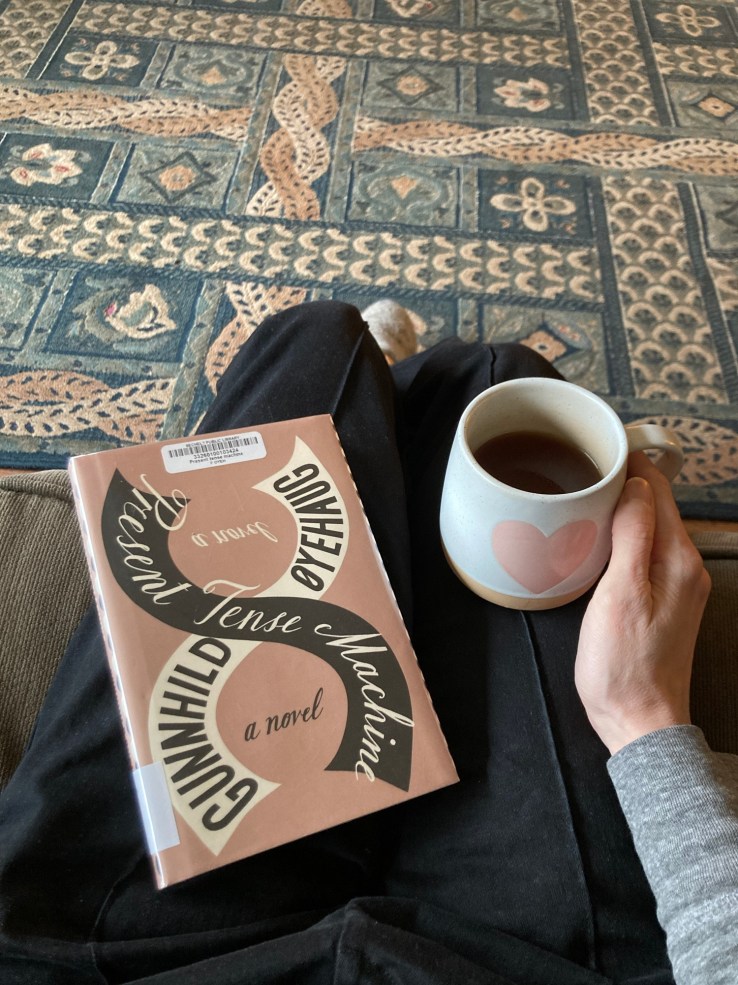
This is a book more about a concept than a story. Which isn’t to say it’s not an interesting book, it’s just a book where it’s more about the idea than the plot or the characters.
Anna and Laura are mother and daughter but one afternoon, while a young Laura rides her bike on the street and Anna sits nearby, reading a book, Anna misreads a word on the page. And in that second of misreading, two parallel universes are created and Anna and Laura are separated. They both continue on with their lives, not knowing that the other ever existed and in the present timeline of the book, it is twenty years later. Anna has divorced the man who was Laura’s father, never having had a child together, and remarried and gone on to have two children.
Laura is married and expecting her first child. Her husband is a somewhat successful musician but she has largely stopped her own music and is frustrated with her life. In this timeline she was raised by a single father. (There’s no mention of a mother at all here, which is confusing because obviously Laura has to have come from somewhere.)
In both timelines, both Anna and Laura feel vaguely off-kilter, as if something is missing, but neither is able to pinpoint what that might be. The women are similar in many ways. Unsure of motherhood. Musical but not to the point of making a career of it. Trying to write a book. They are both interested in language, unaware that a simple misreading of text altered each of their lives.
The book is just over 150 pages which works because, as I said, there’s not a lot of plot here. There’s a sense of tension from the fact that these two women are living parallel lives in almost the same place. The reader feels that they must inevitably meet. There’s a pull between them and the ways they keep overlapping occur in satisfying ways, building up to something more.
I think this is my first translated work from Norway so I have no idea if this sort of abstract story telling is indicative of anything about Norwegian culture. For a book about language, translation was obviously an important aspect here and I generally found myself forgetting it was translated at all.

 Karissa Reads Books
What a fascinating idea! Books from that part of the world often make me feel particularly off-kilter. I think there is a different way of looking at things that shows up in books written in languages other than English.
Yes! As I’ve started reading more translated works, I’ve noticed how different cultures and countries approach fiction and stories and it’s really fascinating. Sometimes it does make me feel off-kilter!
This sounds pretty cool actually. I don’t think I’ve ever read any Norwegian books (translated of course) either, except for maybe a mystery here or there? I feel as though alot of dark thrillers come out of Norway, but that’s all I’m really familiar with…
Yes, those Nordic writers are known for being pretty dark! I don’t think I’ve read any, mostly for that reason. This wasn’t dark just very unusual, and I did enjoy that.
I’ve read books from that part of the world, and it does seem that they tend to write in thought experiments. One was about a guy who stared at this specific part of the wall all day at work because he could see a room that wasn’t there.
That sounds like it could fit into this world! It’s so interesting to see how different countries/culture explore various topics.
[…] Present Tense Machine – Gunnhild Oyehaug […]