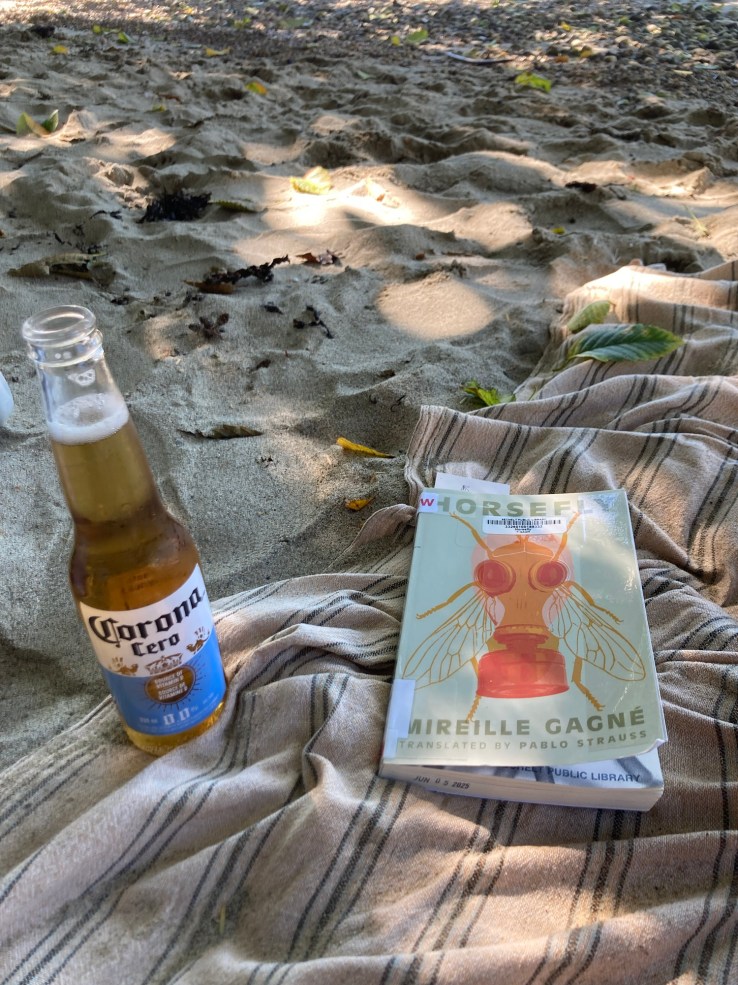
I’ve read enough Quebecois literature in translation by now to know that it’s all a little bit weird. But always in a very fascinating way. Horsefly is a story told in two timelines with two different men. Thomas is a French-Canadian scientist in 1942. He is recruited to join a top secret military operation, located on an island in the St. Lawrence River. There Thomas, along with soldiers and other scientists, experiment with methods of bio-chemical warfare. Thomas’ expertise is insects and he begins to investigate ways to spread disease through horseflies.
In 2025, Theodore lives a straightforward, lonely life. He lives alone, occasionally visiting his increasingly volatile grandfather in a home. Theodore works in a factory under stifling conditions, otherwise drinking himself into a state of apathy. The city is suffering under a prolonged heat wave and the horseflies seem worse than ever before.
It wasn’t hard to sympathize with Theodore as I read this book in the August heat, after dealing with terrible mosquitoes on our recent road trip. While we don’t get many horseflies here on the West Coast, I’ve certainly experienced them when spending summers in Ontario and their bites are vicious. It was easy to imagine them as being harbingers of greater disease.
The premise of Horsefly is strong. It’s loosely based on real experimentation that occurred in Quebec during the Second World War. And with rising temperatures around the world due to climate change, it’s not hard to imagine becoming more vulnerable to diseases that we haven’t much worried about before in Canada. With biological warfare in one timeline and climate change in another, the novel naturally has a lot of tension.
Where the book faltered for me was in the lack of character development. Both Thomas and Theodore are fairly passive characters. For both of these men, things happen to them. Rarely do either of them take action or create change for or around themselves. Thomas is better in this area both because he’s clearly operating under the orders of a larger structure (the military and government) and so naturally less able to make his own choices. Of the two though, he’s also the one who does seem to do more to alter things for himself. Theodore really doesn’t do much. He goes to work, he goes out, he visits his grandfather. Even when he does take surprising action, it doesn’t really seem like he’s making a conscious decision. I really wanted to root for these characters but the book never fleshed them out enough for me to fully care.
Interspersed with the two human characters, we also get the perspective of a horsefly in 2025 which is delightfully creepy and made my skin crawl. Not to mention having me side-eye any insects that make it into my house these days.

 Karissa Reads Books
“I’ve read enough Quebecois literature in translation by now to know that it’s all a little bit weird.” You know what’s funny as I read that and thought, oh yeah, the one book that I’ve read from the Quebec region that was translated was super weird! Now I’m wondering if that’s just the style of that province? Of course, my one book experience can’t tell me either way, but now I’m intrigued. What do you mean by a little weird? The book I read, which I believe was titled Mile End, just didn’t feel like it was set in reality but was still realistic. I’m aware that makes no sense.
I don’t even know exactly how to pinpoint the weirdness. There’s often a sense of playing with language that goes beyond it being a translation. There’s often a sense of displacement, maybe, characters who are slightly off-kilter in the world. Quebec exists in this in-between sort of way. A lot of a Quebecois literature feels more European in the topics it’s willing to address, like sexuality or bodies. But it’s not European. But it’s different from the way the rest of Canada writes. It’s a little bit less tied to the real world. I imagine it comes from Quebec being part of Canada and yet having a unique spot within the nation but I really don’t know.
Ugh horseflies are nasty. Like black flies but their bites are so much more painful! Any story told from a bug’s perspective is bound to be creepy haha
Horseflies are terrible! I can vividly remember being bitten as a kid, sitting in a rowboat on a lake!
[…] appreciated the translated works I read but it’s hard to say that I loved many of them. In Horsefly I learned about a part of Canadian history I hadn’t known. In Palace Walk I got to be […]
[…] Horsefly – Mireille Gagnon […]