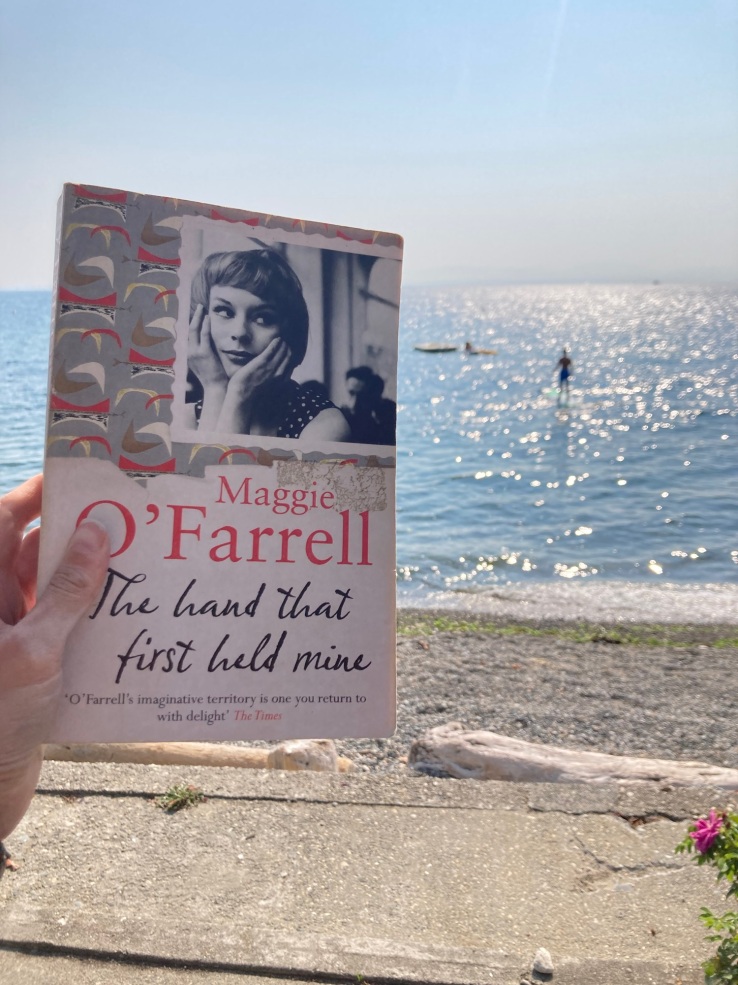
My introduction to Maggie O’Farrell’s work was through her most recent novels, both of which are historical fiction. (My review of Hamnet and of The Marriage Portrait.) This earlier work from O’Farrell has a twentieth century setting and maybe it was this or the fact that O’Farrell was still honing her style, but if you hadn’t told me, I don’t think I would have identified this book as O’Farrell’s work. In fact, what it reminded me most of somehow was early Kate Atkinson, particularly Behind the Scenes at the Museum.
We have two timelines in this novel. The features Lexie Sinclair in the 1950s and 60s. We meet her at her parents’ home, shortly after she’s been kicked out of university. A chance encounter with a man named Innes Kent spurs Lexie to pursue her dream of moving to London. It’s an entire upheaval of her safe, conservative life as she falls in love with Kent, lives in Soho, and meets all kinds of delightfully unsavoury characters.
In the present day, we have Elina and Ted who have just welcome their first child. After a traumatic birth, they are struggling to adjust to parenthood. Elina is in pain, confused, and overwhelmed. Ted, meanwhile, is reeling from the shock of almost watching Elina die and at the same time realizing that his childhood memories don’t match the stories he’s always been told by his mother.
Obviously, these two timelines are going to be connected in some way but I did appreciate that that connection isn’t immediately obvious. And on the surface, these two stories don’t have a lot in common. Lexie is young and smart and struggling to find her place in a world entirely different from the one in which she was raised. She’s a lovely character in that she’s far from perfect, makes some unexpected choices, and yet stays true to who she is figuring out that she is.
Elina and Ted were a bit harder for me to get a read on. Their relationship has a tenuous feel, like a couple who haven’t been together very long before throwing in the difficulty of a baby. Elina is a Finnish artist who moved to London while Ted has lived in London his whole life. They love each other but they are struggling to find their relationship within their new roles as parents. Both overwhelmed and frightened, they don’t know how to express these feelings to each other. I thought O’Farrell did a very good job of depicting those early, exhausting days of parenthood, adding to that Elina’s difficult physical experience. Neither Ted nor Elina is doing anything wrong but they struggle in making sure they are on the same page. As Elina begins to improve, Ted begins to fall apart, realizing that his own history is not what he thought it was.
I was disappointed in this shift from Elina to Ted, primarily because their timeline seemed like it was a story of early motherhood and what it was to navigate that. But instead of getting closer to Elina and who she was, the story (and Elina’s life) becomes about Ted and how this is affecting him. His struggle is real but I was sort of annoyed to have him centred in a book that seemed to be about motherhood.
The ultimate reveal of the connection between these two timelines comes just as the reader is figuring it out for themselves, which is my favourite kind of reveal. It gets very sad at the end and there’s an interesting exploration of how early trauma in childhood can shape us in ways we are not even aware of. I would have liked to see more of that, actually, and so for me the book ends just a little too soon.
You can see here that O’Farrell is a talented writer but not yet at the height of her skill. It’s exciting that we are still getting work from her and can see how she has honed her craft since.

 Karissa Reads Books
I think I’d like this one. I’ve only read The Marriage Portrait from what I can remember, and I did enjoy it. I see why the switch to Ted’s storyline would be a bit jarring, the way you summarized the book did make it seem like motherhood would be at the center of everything…
I think you’d like it too. It’s not as polished as her more recent work but it’s still very good.
If Ted’s chapters were about his feelings with being a new parent, I would be interested in that because I don’t think we hear a lot (and some people don’t care because new fatherhood seems like nothing compared to new motherhood) about fathers in the early parts of having a baby. Recently, we had chipmunks in our attic. The technician who came out was trying super hard to be friendly, asking how long we had been married, etc. Then, he mentioned he has a fairly new baby. I asked how that is going. He paused for a long time before replying, “The first five weeks really sucked.” I felt like no one has asked him because we all naturally focus on the mother, who has recently performed a bodily feat, and continues to do so, by giving birth and breastfeeding.
That would be a really interesting book. Though I wonder how it would be coming from a female author. Part of me thinks it’s fair that we don’t focus much on the father experience of becoming a parent but at the same time it’s a huge shift for men too and they don’t have the same physical experience to help them adjust. It struck me once that I’ve never seen a baby be born but Peter has, twice. And while I got to be caught up in the moment and worry only about my babies, he had to worry about me too.
Ted’s sections were more about how becoming a father unburies trauma he experienced as a child that he didn’t realize. Which was interesting but not what I expected from the book.
[…] The Hand that First Held Mine – Maggie O’Farrell […]