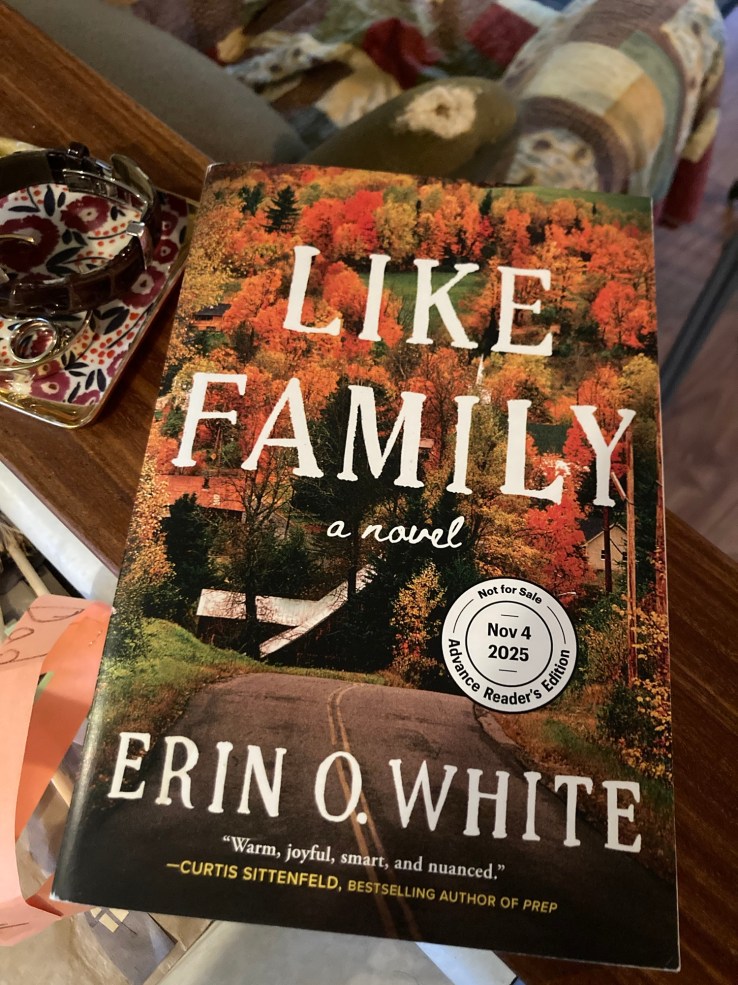
I received an Advance Reader’s Copy of this book thanks to the publisher. All opinions are my own.
After hearing some positive early reviews of Like Family, I realized I had an ARC at home and so picked it up to read over a weekend. I was immediately engrossed and extremely impressed by this debut author.
The central relationship at this novel about 3 families is a friendship between Ruth and Caroline. They are both women in their 30s, mothers, living in a small community in the Hudson Valley. It’s an artsy, liberal place, the kind of town where people tend to be linked in more than one way. (Very familiar to my own small town experience.) Ruth and her wife Wyn have 4 children while Caroline and her husband have one son. Ruth and Wyn’s family is large and chaotic; they’ve recently bought a farm and are navigating their new family dynamic as their kids get older. Caroline worries about her son, Luca, who doesn’t quite fit in with other children his age. In each other’s families, they’ve found an extended chosen family, a place of support and companionship that is incredibly meaningful to both of them.
The story begins with Ruth sharing with Caroline the truth behind the fact that Ruth’s eldest daughter has a different father than the younger three children. While the youngest children were the result of a sperm donor, Siddha’s father is a man that Ruth had a brief and complicated relationship with. Siddha, who is now a teenager, only learns about this when her birth father suddenly dies and it turns out he lived in the next town over. His death and this revelation has repercussions in Ruth and Caroline’s friendship as Ruth figures out how to navigate this rupture.
The third family in the equation are Tobi and Evie. Tobi is Caroline’s husband’s cousin but really as close as a sister, although Caroline feels that Tobi has always kept her at arm’s length. Tobi and Evie run a successful local business and an instagram page that Ruth is obsessed with. They are the parents to twins and here, again, the idea of who and what makes a family is brought to the fore in a complicated manner.
On one hand, as I type out this outline, it feels like you could extract Tobi and Evie almost completely from the story without much damaging it. It was Ruth and Caroline’s friendship – that heavy and beautiful dynamic of two mothers who are seeking something meaningful outside of their role as mothers – that drew me in most. I really loved their friendship on the page; it felt honest and interesting and fresh and desirable. I wanted to hang out with Ruth and Caroline. I never felt as invested in Tobi and Evie.
At the same time, this really is a story about chosen family. What it means, how to build it, how it can be both incredibly strong and terrifically fragile. And so from there, Tobi and Evie add an interesting dynamic to the conversation. Because Tobi and Mike are actual family but Caroline values Ruth in a greater way. There are layers to this that I don’t want to give away and White handles each one with care.
The central tension is around the death of a man that none of them (even Ruth) really knew. But it’s a greater story about community and family and friendship and the choices we make with who who choose to fill our life. Beautifully told.

 Karissa Reads Books
This sounds great! I’ve recently returned to living in an interconnected community and am constantly being surprised by the multiple layers of connection.
It’s kind of fun but there are added complexities too, which the book does a good job of demonstrating.
Yes, I’ve noticed the complexities of living in a smaller community, too. So far the benefits far outweigh the trickier bits.
[…] Like Family – Erin O. White (Dial Press, 2025) […]
The community is homogenous, so I wondered if the families felt any tension from differences of opinions, or if they’re all pretty much in agreement about their values and how to be a “good person.”
Yes, that’s definitely something that comes up! The central relationship is the friendship between Ruth and Caroline and this begins to be fractured when one of the women behaves in a way that the other views as wrong. (And is also maybe a little jealous of.) White explores that dynamic in an interesting way, I thought.
[…] Like Family – Erin O. White […]