
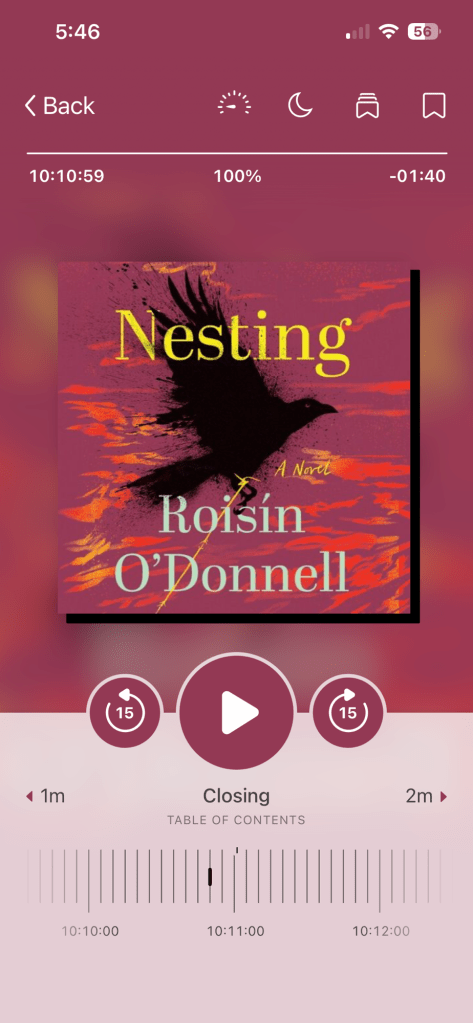
Ciara’s husband, Ryan, has never hit her. So when she decides, on the spur of the moment, to leave with her two young daughters, grabbing the laundry off the line and loading up the van, she isn’t sure that she’s made the right decision. Her mother and sister encourage her but they are far away in England while Ciara is stuck in Dublin. Ryan won’t let Ciara leave the country with the children and he has always controlled all of their money. Ciara joins a seemingly endless waiting list for housing and moves into a hotel in the meantime, while Ryan mounts a campaign to win her back, or at least take the children from her.
A friend had read Nesting before me and I found myself going to her multiple times to ensure that the book had a happy ending. I listened to the entire thing with a low level of stress and anxiety because it felt like at any moment things could go terribly wrong. Ryan isn’t physically abusive but it’s clear from almost their first scene together – a family outing at the beach where Ryan becomes angry that their two- and four-year-old daughters don’t want to swim in the ocean – Ryan isn’t a loving husband. He’s controlling and domineering and his temper pivots on a hairpin. Ciara has spent so long walking on eggshells that she doesn’t know anymore what normal should look like.
The story is also incredibly frustrating because Ciara makes many poor decisions. She doesn’t want to accept money from her mother and sister, who want to help her from afar. She’s in the early stages of pregnancy when she leaves Ryan but doesn’t take the opportunity to tell her healthcare providers that she’s living in a dangerous situation and the baby’s father isn’t safe. More than once, she allows Ryan to worm his way further back into her life than is safe (all against her best instincts). I wanted to yell at her through the page – “Girl! You’re in danger!”
At the same time, every time Ciara faltered in her decision to leave her marriage, I was reminded of the fact that it’s so much easier to judge from the outside. Over and over again, I thought, This is why women don’t leave. This is why it’s so hard. O’Donnell shows us the flawed system from the inside and it’s so frustrating. Ciara can’t label Ryan’s abuse as such because our society doesn’t clearly label such behaviour as abusive. She questions every decision and wonders if he’s right because she objectively does seem to be ruining her children’s lives. To take them from a two parent home to live in a hotel when she has no support and not job does seem like madness. Unless it’s the only option to remove them (and herself) from danger.
O’Donnell does this not by creating villains within the system but by showing how easily the system fails. Ciara is able to access some resources – she is able to stay in the hotel, she eventually is connected with a lawyer – but she has to work hard for that. The lists are long with not enough housing space for those who need it. Those who work in the system are overtaxed and hurried. The doctors and nurses can only respond to what they see or what Ciara tells them.
The tension ramps up the more Ciara makes moves to separate her life and dependence from Ryan. This too felt true to life. The less Ciara needs Ryan, the less likely she will return to him, and the more desperate he becomes. More stress is brought on by the fact that Ciara is still mandated to allow him time with her children, something she knows is not safe. I was pushing through the last part of the book, desperate to know that Ciara and her children came out okay. For a debut novel, Nesting is incredibly strong. But I’ll need to take a breather before diving into something so dark again.
The narration by Louisa Harland was great with one big exception, for me. Any time one of the children had a line, Harland put on what I can only call a “child voice” that was absolutely grating. I get that she was trying to depict a young child speaking but it was so nasally and whiny (even when the kids weren’t whining). The dialogue for the kids as written was actually quite strong and I think it would have been clear that a child was speaking without the annoying voice.

 Karissa Reads Books
I don’t listen to many books, but wonder if stories like this are better when read on paper. I think the reader would manage the anxious sections better by being able to look up from the page, rather than pausing or stopping the audio version.
That is definitely the case for me. Books with high stress or violence, I find easier on paper because I can skim those difficult sections. Audio really forces you to experience every word. Thankfully, this book wasn’t descriptive around the abuse Ciara experiences but I have had audiobooks I’ve had to stop for that reason.
Wow, this does sound harrowing, and I know what you mean by judging this lady from the outside. I would try to keep in mind that we’ve only really acknowledged mental and emotional abuse in the last maybe ten years. I’m sure growing up you never heard anyone in the circle of grown ups around you talk about leaving a spouse because he was manipulative, short tempered, etc. We just all stuffed that crap down and normalized it because, well, he wasn’t hitting. And then if he hit, it was, well, he only hit the one time. It’s not normal. Etc. I saw an avant garde horror movie called Men that is about what happens to a wife after her husband hits her one time. The whole thing is about processing grief, and there are a few moments that lean into the horror genre (especially at the end), but a lot of it feels more like a movie about domestic violence. If you’re interested in know more about why women don’t leave or seem stupid/stubborn in these situations, I recommend once again the book No Visible Bruises: What We Don’t Know about Domestic Violence Can Kill Us by Rachel Louise Snyder.
I think this book did such a good job at showing the non-physical abuse that can occur and is absolutely abuse but also isn’t so cut and dry. It was so good at reminding those on the outside of how it’s easy to say “leave him” but so hard to put into practice. You’re right that I don’t remember anything like this being talked about when I was a kid. Abuse was physical or nothing. One thing I appreciated here was that while it depicted the issues in the system, once Ciara was able to accept that Ryan was abusive, people around her were ready to help. A large part of it was her having to accept that what he had done was abusive.
Oh man this does sound like a tough book, I would struggle with it the way you are for sure. I would have the exact same reactions – frustration she wasn’t leaving him sooner, but also knowing it’s easy for us to judge on the outside.
That child-like voice on audio would have driven my crazy LOL
It’s so stressful and I think it’s because it’s so believable.
The child voice was super unnecessary and every time she did it, it took me out of the story.
[…] Nesting – Roisin O’Donnell (Hachette Audio, 2025) (narrated by Louisa Harland) […]