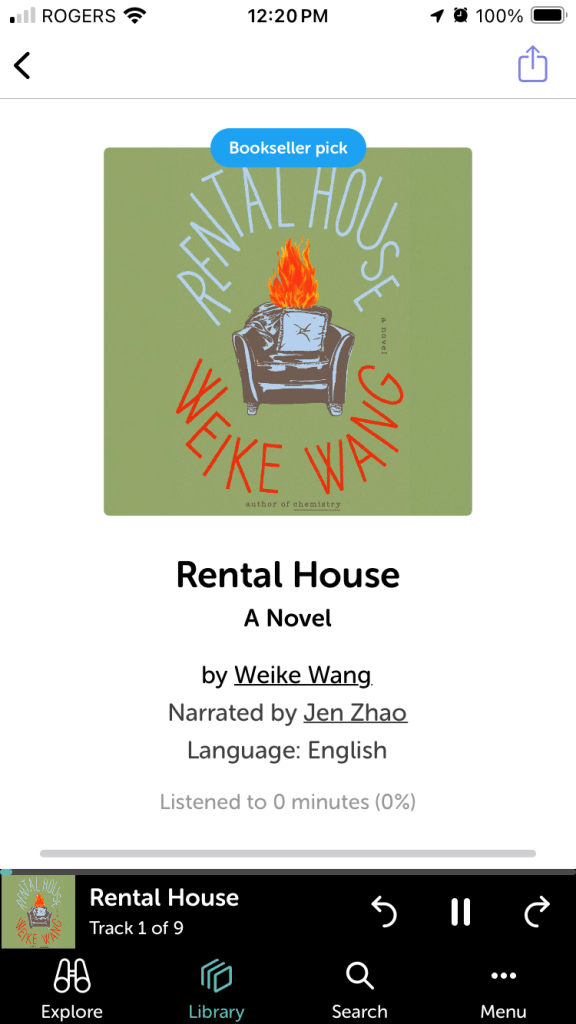
I received a complimentary audio copy of this via Libro.fm. All opinions are my own.
Rental House follows a couple – Keru and Nate – several years into their marriage. They are young professionals, living in New York City, childless by choice, owners of a large and beloved dog. The book is divided into two sections, with each taking place in a vacation rental property.
The first rental is in Cape Cod where Keru and Nate divide their vacation time between their two sets of parents. Keru’s parents come to stay with them first, followed by Nate’s parents. Through these two visits we see the very different backgrounds of Keru and Nate and the tensions that exist because of this. Keru is a Taiwan-American immigrant, having moved to the USA when she was a young child. Her parents have worked hard to achieve success and expect nothing less from their only child. (Early on in the book, we witness a scene where Keru’s father tells Nate it’s ok for him to use a dishwasher but he expects better from Keru and that to use the dishwasher would be a sort of laziness.)
Nate, on the other hand, comes from a white American family in a rural area. He grew up poor and is the first of his family to pursue advanced education. Nate’s family is right-wing, outraged by any sort of Covid-19 restrictions (the first part of the story is set around 2022), and casually racist even while telling Keru they love her. Keru’s parents are so strict in their Covid precautions that they refuse to leave the rental house. They have worked hard to achieve success in America but are still largely isolated as minorities in a mostly white community. They tend to find it unbelievable that a family all born in the USA (like Nate’s) could actually be impoverished. Both sets of parents dislike the dog and are disappointed by the lack of grandchildren.
The tension is crackling throughout the first half of the book. Keru and Nate are largely on the same page in their relationship but they are both tense in different ways as they prepare for their parents’ visits. They feel both loyalty to their parents and an intense exhaustion and Wang really brings these emotions alive on the page. Keru is strangely aggressive at various points in this section and I never quite understood what this was supposed to tell us about it and why Nate seemed so passive in the face of her aggression towards others.
In the second half of the book, we are five years in the future and Keru and Nate have rented a bungalow in the Catskill Mountains. This time they have no plans to include family in their getaway but they become involved with the family renting the bungalow next to them. The tension here is mostly between Keru and Nate, highlighted by the differences in their lives and the couple next door who are younger than them and have a child. There’s tension between Keru and Nate who somehow seemed stalled in their lives – not because they don’t have children but maybe because none of the issues they had five years previously have been at all resolved. The first half of the book ends at the moment of highest tension but the second half barely acknowledges that incident.
At the same time, things with the couple next door become increasingly uncomfortable as their stay progresses but this doesn’t evoke the same level of conflict as there was in the first half of the book. In the first half, the tension was that these are all their family members. Ie: people they will have in their lives forever. Tension with neighbours at a holiday rental isn’t the same because at the end of the week, you know they’re never going to see these people again. I would have much preferred to see more intimately where those family relationships were five years later. Instead, most of what we learn is off the page and we’re told about it rather than witnessing it unfold.
So in the end I have very mixed feelings about this one. Listening to it on audio, it’s less than 6 hours long and Jen Zhao’s narration is well done. The cross-cultural aspect of Keru and Nate’s marriage is interesting and felt authentic to me. I appreciated that these familial conflicts felt genuine and had no simple solutions. I wanted more from the book as a whole but I’m also not sure I would have wanted to stay with these characters much longer.

 Karissa Reads Books
Hmm this does sound like a quirky little book. I think I would enjoy reading about it, especially the parts dealing with challenging in-laws! haha Also interesting the comparison v/s the childless couple, and the couple with a child, and how they interact. As more couples opt out of having kids, it will be bring a unique shift to how people relate to one another when they don’t have the typical nuclear family drawing them together…
I thought that perspective of the child-free couple and how their childlessness was steadily alienating them from a certain social circle was interesting. The switch halfway made me feel like I wanted more of two different books but there’s definitely something compelling here.
Fun fact: there is a whole subgenre in horror about couples having uncomfortable experiences with other couples they’ve just met (like the neighbors you mentioned), and then bad things happen because the characters that we’re rooting for are too polite to actually say anything about how uncomfortable they are, which inevitably leads to their deaths. For some reason, perhaps this reason, the more I read your review, the spookier it felt to me! But I can see how reading a book about a couple who won’t solve their problems and just float through life could be really frustrating.
There’s a book by Ian McEwan called The Comfort of Strangers that’s essentially that, though it’s not really marketed as horror. I did not enjoy reading it! This one really doesn’t feel like horror at all, there’s no sense of danger, just intense social discomfort. I think the way this couple deals with their issues is actually probably really realistic but not super fun to read about.
People will avoid the label “horror” because they’re afraid it will turn off more “literary” people, but it is what it is. When Silence of the Lambs won the academy award, everyone said it was a “thriller.” Hahaha, well then why is it so scary?
That’s very true. Looking back at the plot synopsis of this McEwan book, it reads like horror but he’s not considered a horror writer. Lots of times people will avoid any type of “genre” label because that is perceived as less literary.
I think Cormac McCarthy is the one who slips by most often.
Oh, yes! The Road is definitely a horror story!
This sounds like an interesting premise, although the switch halfway through without following up on the family relationships would have frustrated me as well. It almost sounds like two different novels bolted together!
It made it feel rather incomplete to me. Kind of like reading two parts of the same novel but with big sections missing.
[…] Rental House – Weike Wang […]