I feel toward Sarah Polley the way I imagine I might feel if someone from my high school had gone on to be famous. Like a friend’s older sister, or if we had grown up around the same time in the same small town. We didn’t; I’ve never met Polley and I haven’t even followed her career that closely. (I was exactly the right age and audience when Road to Avonlea was airing but I didn’t watch it much. It always bothered me that it wasn’t a 100% faithful adaptation of L.M. Montgomery’s work.) So I’m not entirely sure why I have this feeling about Sarah Polley but whenever I hear about her and her career, I feel proud of her and as though she is a good representative of my generation in Canada.
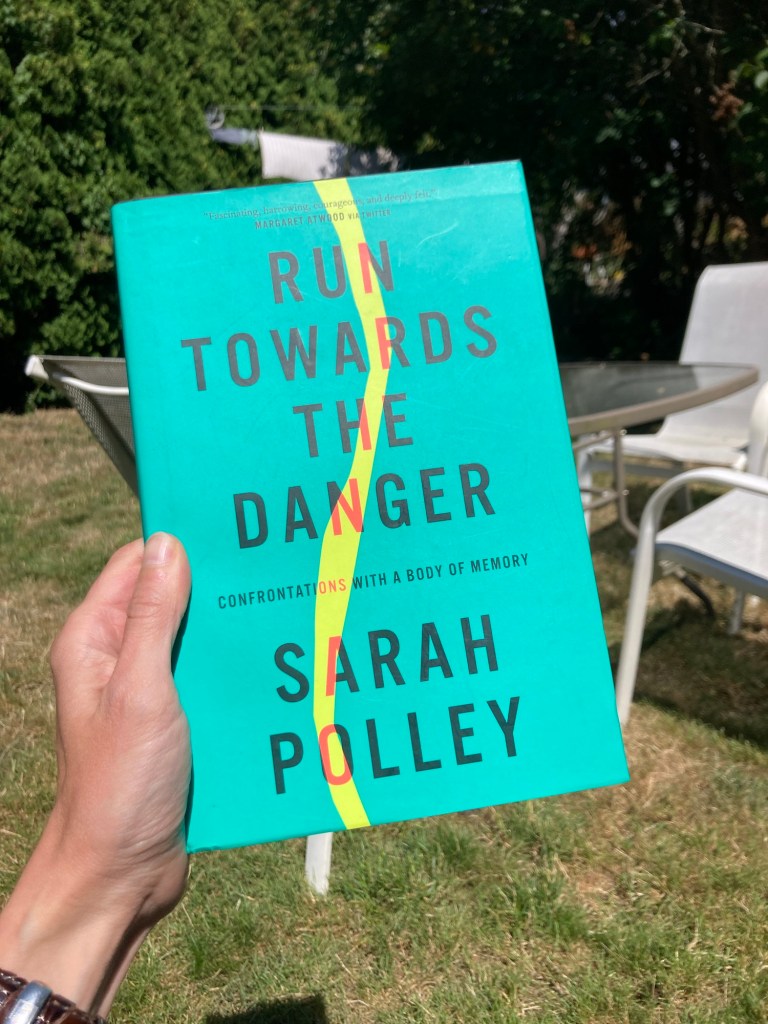
Thankfully, her essay collection, Run Towards the Danger, only solidifies those feelings. I was sold from the Preface when she writes:
When I was lucky enough to have experiences in adulthood that echoed pivotal, difficult memories, and to have those experiences go another, better way than they had in the past, my relationship to those memories shifted. The meaning of long-ago experiences transformed in the context of the ever-changing present. (pg 2, Run Towards the Danger)
This is something I have thought about more than once, particularly in the context of parenting. Raising my children, I see in them sometimes glimpses of myself, who I was as a child. It has made me gentler and more forgiving on my own memories. And getting the opportunity to help them or guide them or just be with them in ways that I might have wanted in my own childhood, has helped me understand myself and my history better. (Please understand: I do not see my children as copies of myself or a chance to “relive” anything. Simply that while they are entirely their own persons, they also share some things with me and the child I was.)
Broadly, for those who don’t know Polley, she was a child actor, most known in Canada for starring on a TV series called Road to Avonlea. She started acting at a young age and had a major role in a Terry Gilliam film in 1988. Her mother died of cancer when she was 11 and after that, Polley was largely independent. Once released from her Avonlea role, she went on to star in mostly independent films, playing very different roles than the one that made her famous. In more recent years, she has turned to directing and writing and while she isn’t someone you hear of all the time, she is definitely someone who is making interesting moves and choices and if I hear that Sarah Polley is attached to something, I know it’s going to be thoughtful and well done. One of her most recent roles was writing and directing the film version of Women Talking by Miriam Toews.
This book consists of 6 essays, each focused on a unique topic or time in Polley’s life but coming together to paint a broad picture of who she is and her history. In the first essay, “Alice Falling”, we are introduced to Polley’s relationship with her father, primarily after her mother’s death. She details her role as Alice in a stage production of Alice in Wonderland at a Stratford theatre and the intense stage fright that she developed from there. It is a story of her father, of adolescence, of her experience with scoliosis. It also introduces us to a theme that runs through her childhood, which is that of a lack of care. This is expanded on in the essay “Mad Genius” which is about her time making the film The Adventures of Baron Munchausen when she was 8-years-old. She writes of her time on TV sets and in films and on stage with the clarity of a now adult and mother of her own children. Someone who sees clearly now both how the adults who should have protected her did not, and also how she, as an adolescent, was too afraid to ask for help from those who would have been willing to offer it.
“The Woman Who Stayed Silent” is a powerful essay about sexual assault and why women choose to come forward or stay silent. It focuses around the 2014 accusations of assault and subsequent trial of Jian Ghomeshi. I’m not sure how widely known his name is outside of Canada but Ghomeshi was a big name in Canadian media up until this point. In 2014, multiple women came forward with stories of him sexually assaulting him. He was ultimately found not guilty and these women were largely torn apart in court but Ghomeshi’s career has been non-existent since. Polley did not come forward at the time but she had an encounter with Ghomeshi as a teenager and now, in this essay, she details that experience as well as examining why she chose to not name herself during the trial. It’s a moving portrait of the complications that women face when they have to choose whether to name their assaulter. Keep in mind, this was before Harvey Weinstein or the #MeToo movement.
Strangely, before I started reading this essay, I had a memory of reading an essay years ago that I thought Polley had written. In it, the writer tells the story of a very bad date with an unnamed Canadian celebrity and how he treated her poorly. Although the man is never named, it seemed widely understood that he was Ghomeshi. To the point that when I first heard of the accusations against him back in 2014, I thought, “Oh right, well, we kind of knew about that, didn’t we? Didn’t Sarah Polley warn us of this?” Polley makes no mention of this essay and so I don’t think it was actually her who wrote it but I also can’t find any trace of it from anyone when I try to search it now.
This review is getting long and I haven’t even touched on every essay. But I do want to highlight the essay “High Risk”, which brought me to tears at least three separate times. This is where Polley details the experience of her first pregnancy. After being diagnosed with gestational diabetes and then placenta prevue, she is deemed “high risk” and she spends the final weeks of her pregnancy in hospital before her baby is born via C-section. Baby Eve spends time in the NICU and Polley struggles to recover and to establish breastfeeding. My story is not Polley’s but I also had an unexpectedly complicated first birth experience, an unexpected C-section, a baby in the NICU, and a struggle to begin breastfeeding. There was so much in this essay that brought me back to that experience 10 years ago and Polley’s honesty and vulnerability made me cry. From the surreal experience of hearing a doctor in the OR say that they were putting your uterus “back in” (It was outside of me?) to the realization that your baby is the biggest and loudest in the NICU (and yet you’re still terrified) to the unreasonable pressure you put on yourself to exclusively breastfeed even to the detriment of your own recovery (never sleeping longer than an hour at a time because nursing and pumping are so all-consuming). But perhaps the thing that spoke most to me was Polley sharing her sense of something being wrong with her body, the sense that of course you don’t have the inability to have an uncomplicated birth and a healthy child. I’ve never heard of seen this expressed before but it brought me back to the early days before my first pregnancy and how quickly I despaired when I didn’t immediately become pregnant. For some reason, I had always assumed pregnancy would be hard for me. For Polley, she was diagnosed with severe endometriosis, for myself I learned that I had a bicornuate uterus. For both of us, these were not found until a first pregnancy ended in miscarriage. That sense of foreboding around pregnancy and childbirth even before I ever became pregnant isn’t something I’ve dwelt on much over the years so it was fascinating to read about Polley’s similar but different experience. Did we sense something about our bodies? Or was it simply an internalized insecurity about a momentous life change? Reading this essay, I am left to wonder how many women have experienced something similar and just don’t talk about it.
Clearly, I could write my own essay(s) in response to Polley’s writing. I finished the book and had, again, that sensation of cheering for someone I distantly know. Highly recommend.

 Karissa Reads Books
My first experience with Sarah Polley was the 2004 movie Dawn of the Dead. She plays a main character, and she’s sort of the leader even though she doesn’t have to say that out loud. She’s never someone you have to save. I really loved her in that role, and so I’ve been keeping an eye out for her since then. If you know her name, it seems like she pops up all over the place. I actually didn’t realize she was a child actor.
You’ve mentioned that movie! I’ve never seen it but the movies I have seen her in as an adult are all unique and off-beat roles. She’s made very thoughtful choices and been involved in some very good movies, more behind the scenes these days. Reading about her life and experiences it makes sense that she’s moved her career in the direction that she has and it makes me glad that she’s been able to do so.
It’s funny I feel so similarly about Polley the way do – that pride in what she’s accomplished, but also being vaguely aware of her struggles, and how she’s clearly grown and thrived through them. I haven’t read this one, but I heard her event here in Calgary was life-changing for some people, so I’ve got this on my TBR for sure. Side note, I met Ghomeshi once, and he was indeed, a scum bag hahah
I remember when the accusations against Ghomeshi first came out and how unsurprising it felt. Like, there had been rumours for years. Her essay on the outfall of the court case and why women choose to speak out against abusers or not was very thoughtful.
[…] Run Towards the Danger – Sarah Polley (Hamish Hamilton, 2022) […]
[…] Run Towards the Danger – Sarah Polley […]
[…] Run Towards the Danger – Sarah Polley […]