The Doll Factory is set in London in the 1850s, around the time of the construction of the Crystal Palace. Our main character is Iris, a young woman who, along with her twin sister, Rose, works at a doll manufacturer. Iris is artistic but the work is long and boring and she longs for something more. While Iris and Rose are identical twins, Iris was born with a broken collarbone, something that alters her physical shape, while Rose is scarred by smallpox. Iris’ sister and parents discourage her from stepping out of the narrow box of her life but when Iris is presented with the opportunity to work as an artist’s model she has the chance to try something entirely different.
Alternating chapters with Iris, we meet Silas, a local taxidermist. He is a collector of curiousities and though he makes his living now with taxidermy, he dreams of the day the world will know his name and he is always on the search for something unique to add to his collection.
As Iris becomes involved with the (fictional) painter Louis Frost, a member of the (real) Pre-Raphaelite Brotherhood, she begins to embrace her own abilities as a painter and a world of beauty and romance opens up before her. She doesn’t remember the brief encounter she had with Silas. But Silas remembers and he is creating an entire story and plan in his head that involves Iris.
As I began The Doll Factory, I kind of expected it to follow familiar historical fiction lines. Young girl comes from impoverished background, turns out to be talented, finds love or something, happy ending. Some of those elements are there but MacNeal is telling a much more interesting story. Iris as a character was different from others I’ve read in a similar timeline. She’s poor and needs to work for a living but she isn’t impoverished. We see other characters, some children, who are truly struggling to survive and so we see that Iris’ background allows her more dignity and slightly more choices (not many though) than some women in her vicinity. Iris isn’t upper class but she is also still largely held back by a strong sense of social propriety. Her parents don’t want her to model for Louis because it isn’t “proper”. The Pre-Raphaelite Brotherhood painters come from wealthier backgrounds and they are all men; they are largely ignorant as to the position they put Iris in when she chooses to spend time with them. They have a freedom that Iris can never quite experience, simply due to gender and class.
As Iris forges a path to increased freedom, the reader is ever mindful of Silas lurking in the shadows. When first introduced, he seems strange but harmless, but MacNeal steadily reveals his truer nature as we delve deeper into his mind and his memories. I found myself wanting to find Silas unrealistic – the world he builds up in his mind that involves Iris, who can’t even recall his name. At the same time, I’m sure I’ve heard news stories of men targeting victims after a single sighting of a woman. I can think of women I know who work with the public and have had men misinterpret their friendly customer service. Silas didn’t feel too far out there and that’s the creepiest part of all.
The setting of 19th-century London and particularly the energy and industry surrounding the building of the Crystal Palace is one I’ve come across in fiction before. But I felt that MacNeal used it well to demonstrate the feeling of a new era in a large city and the possibilities that such an opening may have provided.

 Karissa Reads Books
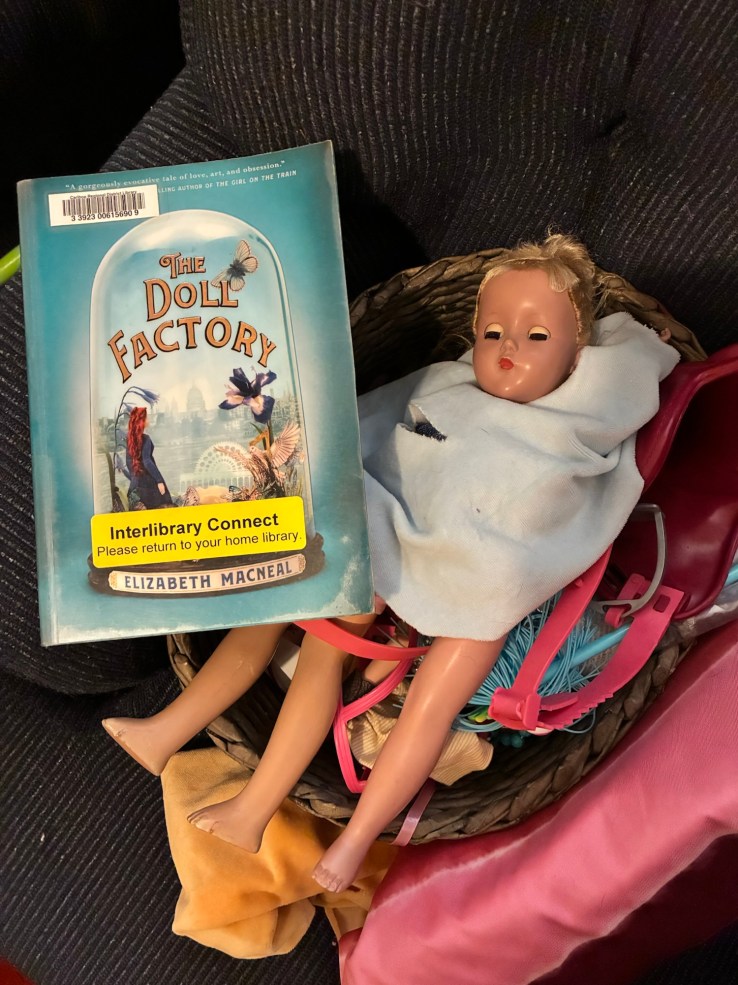
That’s a terrific photo of the book, Karissa!
The sister’s story is intriguing even without Silas.
Thanks! I walked into my girls’ room, saw the dolls like that and thought it was perfect! The sisters here are interesting enough on their own. Silas just adds that extra tension and oomph to the story.
Even though it’s been done over and over, the Crystal Palace is one of my favourite settings of historical fiction! I like the sound of this – I’ve seen it at the library a couple of times but never picked it up. Maybe now is the time!
It’s such a ripe setting I can see why authors keep choosing it. I feel like you would enjoy this one, if you do decide to pick it up!
Is Silas gonna stuff Iris?
Well, I can’t spoil it for you!
🤣
Speaking of the creepy Silas – yes, unfortunately that is so true! I’ve worked with women, in all of my careers, that have struggled with men misinterpreting kindness, perhaps even a single world of greeting, that becomes an obsession. This happens so often, I think other men would be shocked to know how common it is. In their mind, I think it’s a twisted idea of romanticism.
I thought the author did a really good job at that portrayal and, you’re right, a male reader might be shocked at how familiar it felt as a woman. She exaggerates it in parts for sure but a large part of the creepiness came from how real it also felt.
[…] The Doll Factory – Elizabeth MacNeal (Simon & Schuster, 2019) […]