
I’ll be honest, what initially caught my eye about this book was that the author has the same name as me, spelled the same and everything! I have enough books to read though that this alone isn’t enough to make me pick up a book. I was drawn in by the setting – from Shanghai during the Second World War to Hong Kong and Taiwan in the 1960s and 70s and then to the USA in the early 21st century. That decades-spanning type of storytelling is often one I find fascinating and the history of China and Chinese immigrants in the 20th century is one I’ve returned to not infrequently over my life.
Haiwen and Suchi are childhood best friends, growing up in the same Shanghai neighbourhood in the 1940s. Haiwen is a quiet boy and a gifted violinist while Suchi is more rambunctious and outspoken and dreams of becoming a singer. Their friendship evolves into a teenage romance but their future plans are painfully disrupted by war and political tensions.
At the beginning of the novel we witness their unexpected reunion in a grocery story in 2008 in California. They are in their 70s now, grandparents, and they have not seen each other in decades. Their chance meeting seems like fate but so much time and history has passed. Are they even the same people anymore?
Homeseeking tells their story from each of their perspectives with Suchi’s story moving forward in time while Haiwen’s (or Howard’s, as he is now known in America) moving backward. We know that they were separated in Shanghai suddenly and we know that they had one previous reunion, years ago in Hong Kong but the rest of the details unfold slowly. We follow Suchi when she and her sister are sent from Shanghai to Hong Kong to escape war and famine and the struggle that Suchi undertakes to survive, as well as the choices she is forced to make. We follow Haiwen backward, through his marriage and life in Taiwan and his time serving in the National Army.
Obviously a story like this covers a lot of time and history and has an expansive cast of supporting characters. For the most part, Chen does very well and depicting these various times, places, and people. We see the ways that characters names change from one place to another and language is an important aspect of cultural identity. Suchi and Haiwen grow up speaking Mandarin as well as Shanhainese (a Mandarin dialect) while learning some English through schooling. When Suchi moves to Hong Kong she must learn Cantonese and she improves her English in order to increase her opportunities. As she makes certain choices to adapt, she also begins to be known by her Cantonese name, indicating a change in her very character. When Haiwen lives in Taiwan, he can speak Mandarin there but his lack of knowledge of the language of the traditional Taiwanese people marks him as an outsider and a soldier. In America, both most learn to function in English. Even in scenes where they are with other Chinese immigrants, English is often the shared language.
I think I have a decent knowledge and understanding of the history of China and Hong Kong in the 20th century and the various political factions and wars and that was very helpful. Chen doesn’t spend a lot of time explaining the significance of the Japanese occupation of Taiwan or the difference between the Communist and Nationalist parties in Shanghai after World War Two. I didn’t mind that because the book is long enough as is but a little research may be necessary.
Suchi and Haiwen felt like very real characters who had very real character development and change. Characters you first meet at the age of 7 should not be the same when you see them at 70 and Chen did a decent job of depicting that, particularly with all the trauma both of them go through.
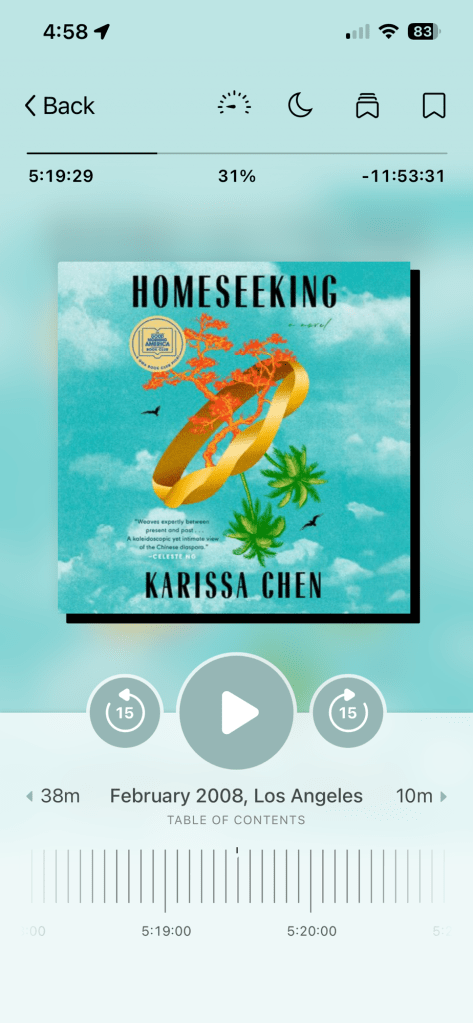
The audiobook narration was split between Katharine Chin and Kenneth Lee, meaning the two storylines and characters were clearly delineated. I struggled a little with the narration, primarily with foreign names taking a little longer to stick in my brain when I couldn’t see them written out, but by the end I appreciated being able to listen to this. It meant I knew all the names of people and places were being correctly pronounced! I also appreciated Kenneth Lee’s lightly accented English, which sounded exactly like so many Chinese men I knew growing up and really fit in with the idea of Haiwen telling this story from the perspective of an older immigrant now living in North America.

 Karissa Reads Books
It’s not until halfway through your review that you mention Suchi has “she” pronouns. I assumed, for some reason, these were both boy characters, and I thought the plot sounded an awful lot like the Oscar-winning film Moonlight!
I always have this goal of reading a book from another country (meaning I don’t know how to say the names, places, etc.) and looking at the text while listening to the audio.
I didn’t even realize I did that! Whoops! I haven’t seen Moonlight – what are some of the plot similarities?
I really like audio for that reason but it is nice to have the words on page so I know what they look like as well as how to pronounce them.
Moonlight is two boys growing up in tragic circumstances who meet back up years later and act on their romantic and sexual feelings, which they had repressed or didn’t acknowledge fully as teens, even after they had an intimate encounter.
Oh yeah, I could see some parallels. In this one, the characters can openly be together as teens but are then separated by circumstances.
Oh, this sounds great! That kind of decades-spanning story is really appealing to me as well and like you I’m interested in the history of China in the 20th century. I have some Audible credits hanging around as well. This is going straight on my list – thanks for sharing your review!
I hope you enjoy it if you do read or listen to it!