
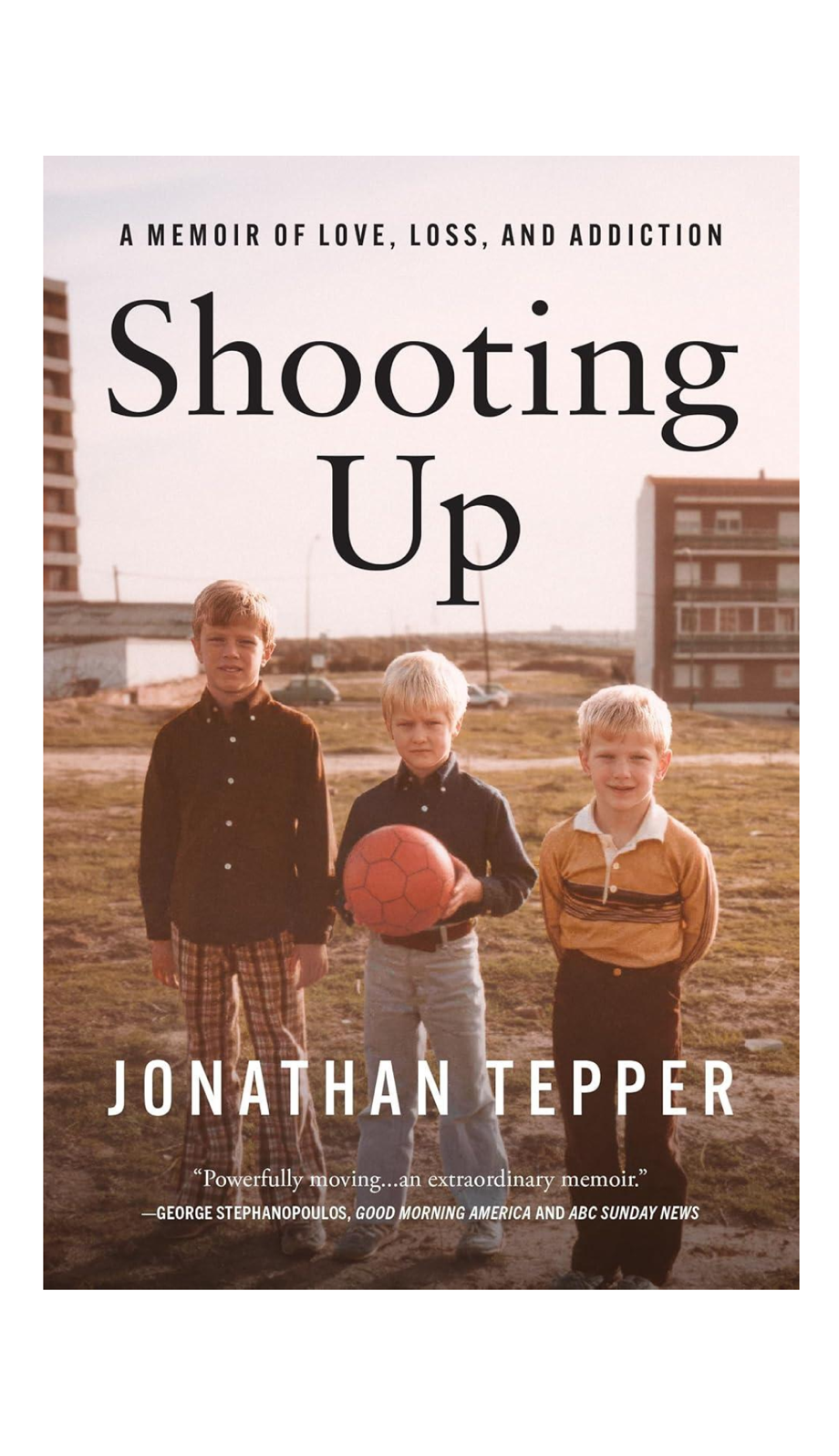
In the 1980s, the Tepper family moved from the United States to Madrid as Christian missionaries. Husband and wife and their four young sons. There they began working with addicts and started a rehab for heroin addicts, many of whom were HIV+ at the height of the AIDS epidemic. Tepper’s memoir follows his years growing up amidst this seeming chaos and the close relationships that he and his family built with the recovering addicts, as well as his later pursuit of education against obstacles and odds.
Jonathan Tepper reached out to me directly to share an e-copy of his book. I was immediately intrigued as another former missionary kid. My story and my family’s history is very different from the Teppers’ but there are some shared truths and experiences. Early in Shooting Up, Tepper writes,
If your parents are engineers, plumbers or lawyers, it doesn’t matter one bit to your life, but if your parents are missionaries, it changes everything. You can’t pick your parents, but they get to pick your life. They decide where you’ll live, when you’ll pack your bags and go, and you’ll get roped into their work saving the lost.
I had to sit with that sentiment for a while and think about whether or not it was true. As a parent now, I do think that the careers my husband and I have pursued have an affect on our children. But ministry families are unique and when your parents are called by God, you can’t really argue. There were multiple times throughout Tepper’s memoir where I paused and thought, That probably seems weird to anyone outside of missionary circles. By many standards, these would be irresponsible parents. They allow active drug addicts into their home. They let their young sons sleepover at a rehab centre without them. They send their young children to the local parks to find heroin addicts in order to hand out religious tracts. It’s the kind of behaviour that would have many modern North Americans calling some sort of protective services and it’s exactly the kind of behaviour that I can see would be lauded by Christian churches. The Teppers are all-in on their faith. They open up their homes, they give freely to others, they work tirelessly, all to help heroin addicts in another country, many of whom are HIV+ in a time when AIDS is very poorly understood. Elliott and Mary Tepper aren’t just passionate, they’re driven by faith.
Jonathan grew up in the midst of all of this, what might seem like chaos. But he writes of it with great love and a good deal of pleasure. It is clear that he didn’t feel endangered by the addicts around him but instead began to view them as his brothers and sisters. Even the one or two who were unkind to him, were quickly put into their place by the others. The community of San Blas is his home, even as he experiences times when he is clearly an outsider. It’s the classic experience of such children who grow up outside of their parents’ home country and culture. By the time Jonathan is old enough to head to university in the United States, he has lived through and experienced things that his peers are entirely unfamiliar with and he feels more like an outsider than he did in the Betel rehab centres.
Education turns out to be a lifeline for Jonathan. Although finances mean that for a time, the family can only afford to send his older brother to school, Jonathan is a smart and curious kid. His family encourages thought and reading and at home, their father is constantly challenging them, quoting great thinkers and immersing them in knowledge.
Tepper doesn’t spend a lot of time delving into where he stands with the Christian faith now and how his upbringing affected his beliefs, but he writes with a lot of respect for his parents and the work that they did. The rehab program they started has grown and spread to other countries. The book is a beautiful tribute to that work.


Your last sentence is really interesting because I wonder at this point if it even matters what his faith is. It seems like his goal is to talk about the effect that having missionaries for parents would have on a child. You’re right, from a non-religious person’s point of view, this does sound radical. Dangerous. Perhaps even like a strange use of one’s time. On the other hand, I have to say that I came into this book review like a total American; I thought the title referred to perhaps a school shooting survivor.
I don’t think his current faith really matters and it’s certainly not the focus of this book. That curiosity speaks more to my own interests and history. I don’t quite know how to explain how much a family like this would have been lauded and held up as an example in the Christian circles I grew up in. I don’t know if you’re familiar with the story of Jim Elliot but he was one of a group of missionaries who went to Ecuador in the 50s with their families and several of the men were killed by the tribe they were evangelizing. That’s the kind of story that was told over and over as an example to us as children. I did not even think of the gun angle but I see it now with the title and the photo cover of the kids!
What was the goal of your group telling you the story of Jim Elliot repeatedly? If anything, I would take from it that Christianity is not welcome everywhere because loads of people are A) terrorized by a history of colonization/stealing children and B) have their own religious practices already.
After Jim Elliot and the other men were killed, their wives returned to the villages with their children and continued to evangelize so a major lesson was one of their forgiveness and bravery in continuing the mission. I once went to a teen conference where one of the sons was the speaker and he shared the stage with one of the tribesmen who killed his father and then later became a Christian. So the deaths of Elliot and the others were seen as a successful sacrifice. Christian missionaries know that their message will not necessarily be welcomed wherever they go and that’s not generally considered a deterrent. I do think many Christians now do have a better understanding of some of the terrible things that the church has done (like residential schools) and many groups are trying to adapt missions to be more sensitive to that history.
Wow, you are a ball of crazy tales and wisdom, Ms. Karissa. ❤