There’s been a real trend in recent years of feminist retellings of Greek myths. (Some personal favourites come from Pat Barker and Madeline Miller and I’ve also enjoyed the novels I’ve read from Natalie Haynes.) All of these retellings assume a basic familiarity with the Greek myths they’re tackling but most of us are not deeply familiar with the history and context of these stories, just as most of us wouldn’t be able to read them in their original language.
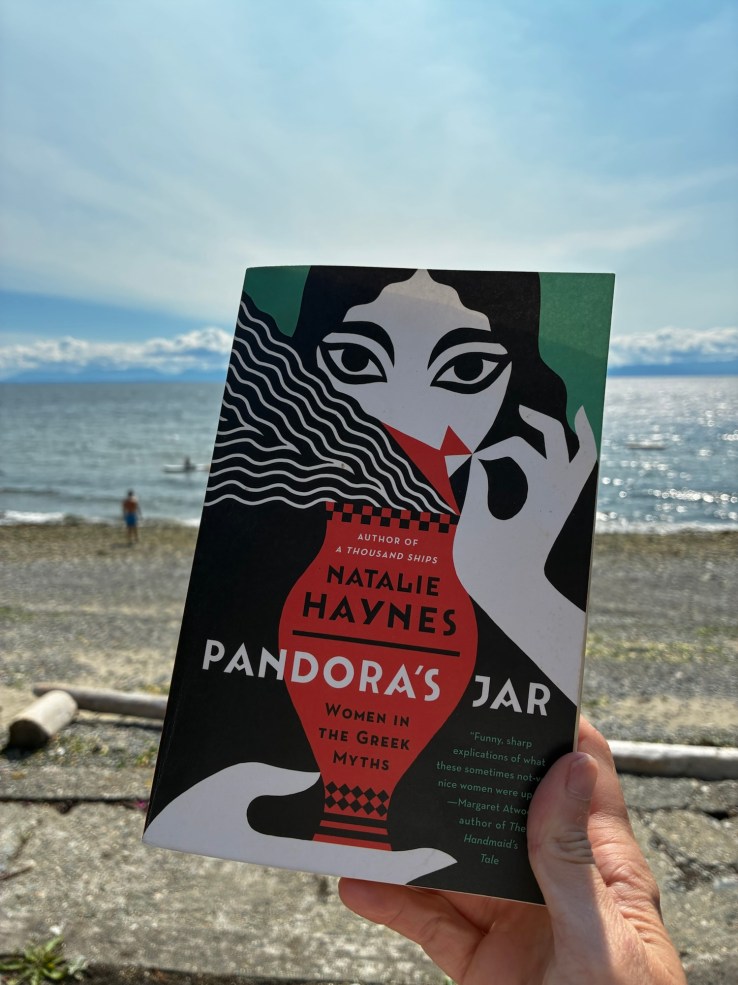
In Pandora’s Jar, Natalie Haynes delves into 10 different women featured in Greek mythology. She looks at the various plays and tales in which their stories are told, as well as the various retellings that have brought them into English. Many of these stories were first presented as plays (and Haynes’ enthusiasm has got me wanting to read or see some Euripedes’ plays!) but have become known to modern audiences through stories for children. Many of these retellings omit or tame down certain aspects of the story or don’t give a full context for how the original audience would have seen it. Haynes shows us where certain modern retellings have diminished the roles of these women in ways that the original storytellers never intended.
The book is written in an easy, conversational style that’s enjoyable to follow. Haynes’ passion for her subject is contagious and it was easy to see how this had translated into some of her novels. While she wrote this before her novel about Medusa, in her section about that famed Gorgon, she’s clearly working with some of the ideas that she eventually fleshed out in Stone Blind. We view these women – be it Pandora, Medusa, Jocaste, or Helen – in a certain way. But why? And whose story are we believing?
I highly recommend Pandora’s Jar for anyone with even a passing interest in Greek history and mythology.


Wait, now I’m super curious. How does she show that the old storytellers didn’t mean to portray women as inferior? You’ve got me crazy curious! I did love that Achilles book, I think, only because the audio version was SO GOOD. It was like listening to a storyteller rather than a recording.
She gets into the original language used and how certain words would have been perceived by the contemporary audience or where else they were used in other stories. Also the roles that a writer like Euripides gives the women and how he chose to portray them or emphasize, even knowing that they would be played by men on stage. It’s really interesting – I know want to familiarize myself with Euripides’ work!
I liked Song of Achilles but I loved her Circe even more. And I think Barker’s Silence of the Girls is the very best retelling.
I hate to sound dense, but where does the author get into the language? I thought this book was fiction, so maybe in an author’s note?
Oh, no, it’s non-fiction! It’s a book of essays. I should have made that clearer. Haynes is known for her novels but this is not one of them.
Ooooohhhhhhh!
😂
[…] that a lot of my reading lately has been for books that have come out this year. After reading Pandora’s Jar last month, I’ve continued on my Ancient Greek kick. I finished reading The Odyssey then […]