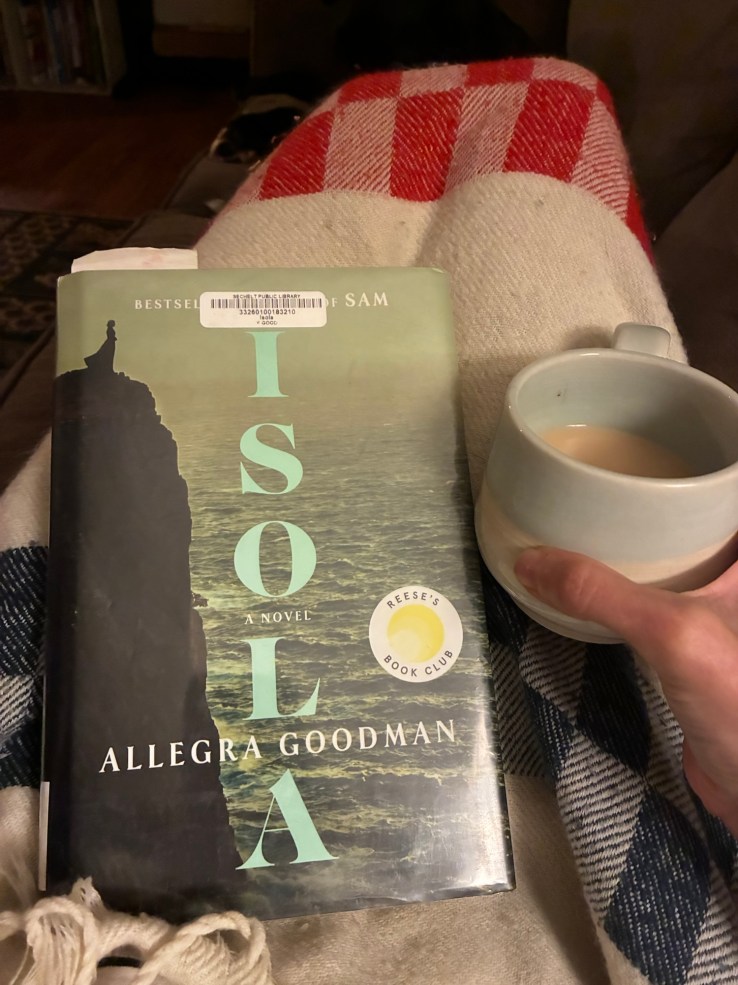
It didn’t take me long after I started reading Isola to realize I’d heard this story before. The tale of Marguerite de la Rocque is one of those folktales that always feels vaguely familiar. I’m not sure if it’s better known in Canada than in other parts of the world but I know I’ve read at least one other novel about Marguerite – Elle by Douglas Glover.
In Isola, Allegra Goodman brings a very different version of this heroine to life. Marguerite is orphaned at a young age and lives a simple, isolated life in her family home. She has servants, her nurse Damienne, and, later, a tutor who brings along her own daughter, close in age to Marguerite. Damienne ensures that Marguerite is being raised as a lady, with all the modesty and talents that this requires. Marguerite has a guardian, Roberval, who visits only occasionally and is responsible for stewarding her property until she comes of age to marry.
But instead of arranging her marriage, Roberval speculates with Marguerite’s fortune and before she is an adult, her dowry and her future seems lost. Increasingly, Roberval is a figure of fear for Marguerite culminating in his decision to bring her with him to New France.
The story is set in the early to mid 16th century and in one scene Marguerite witnesses a conversation between Roberval and Cartier about the newly discovered passageway into the new world. The men believe this will take them across to India but the reader knows, of course, that Cartier has found the St. Lawrence River. Roberval is to return to New France with a group of colonists and claim land for the king. For reasons unclear to her, he decides to bring Marguerite and Damienne along.
It is on this voyage that Marguerite becomes increasingly drawn to Roberval’s young secretary and the two begin a passionate affair. When this is discovered, Roberval chooses to put the couple, along with poor Damienne, on shore and leave them behind. These are the facts of the real-life story of Marguerite as she existed. Opinions vary as to whether the real Marguerite was married to the man she was put on shore with or whether or not she was guilty of an illicit affair. Which side you fall on may depend on your own opinions of women in history. What else is fact is that approximately 2 years later, Marguerite was found alive, alone, and returned to France.
Goodman brings this strange but fascinating historical figure to life. The child Marguerite we meet at the beginning is stubborn but spoiled. She is isolated and largely ignorant, sheltered but subject to her guardian’s whims. She is mostly powerless in her own life and this doesn’t change as she grows older. She does not seem like a person who could possibly survive on a small island in the St. Lawrence River, let alone through such a winter. Yet as the novel moves forward, Goodman does a fair job of showing Marguerite as she is forced to rise to a new occasion again and again. It would feel unbelievable except that the bones of the story are true.
It’s largely unknown what Marguerite’s life on that island would have been like and what Goodman reconstructs is interesting to read – something like reading pioneer memoirs and perhaps not drastically different from what any of the other colonists would have had to contend with in the area that we now know as Canada. Bitter winters, unfamiliar plants and soil, wild animals, illness. But we see the beauty of the place too and there was a lot of satisfaction to watching these characters figure out how to survive.
Personally, I was less interested in Marguerite’s life when she returns to France and the moves she has to make there in order to survive society after such a scandal. At that point the story felt like it was dragging a little long. But I had spent so much time with Marguerite that I still wanted to make sure things worked out okay for her.


Unfortunately, this one does not interest me at all. Also, I can stay with confidence that I’ve never heard of this story before. You say it’s a fairy tale that’s famous in Canada?
That’s fair. I don’t see this as a book you would love.
I don’t know how famous this story is in Canada but I was definitely familiar with it before I started the book. The blurb made it seem like this unknown tale so I was surprised when I realized I recognized it.
I had also not heard of Marguerite before reading your review, but if it’s well-known in Canada then it’s weird that the blurb made it sound like an unknown story! This sounds like an interesting take – shame it dragged a bit when you got towards the end.
This is louloureads – once again I am mysteriously appearing as Anonymous!
I’m not sure how widely known the story is even in Canada but I’d definitely heard it before and have read depictions of Marguerite. I guess the story’s not known in the US and that’s who the blurb is speaking to. Now I feel like I need to survey some fellow Canadians and see how many are familiar with this story!
[…] Isola – Allegra Goodman (Dial Press, 2025) […]