
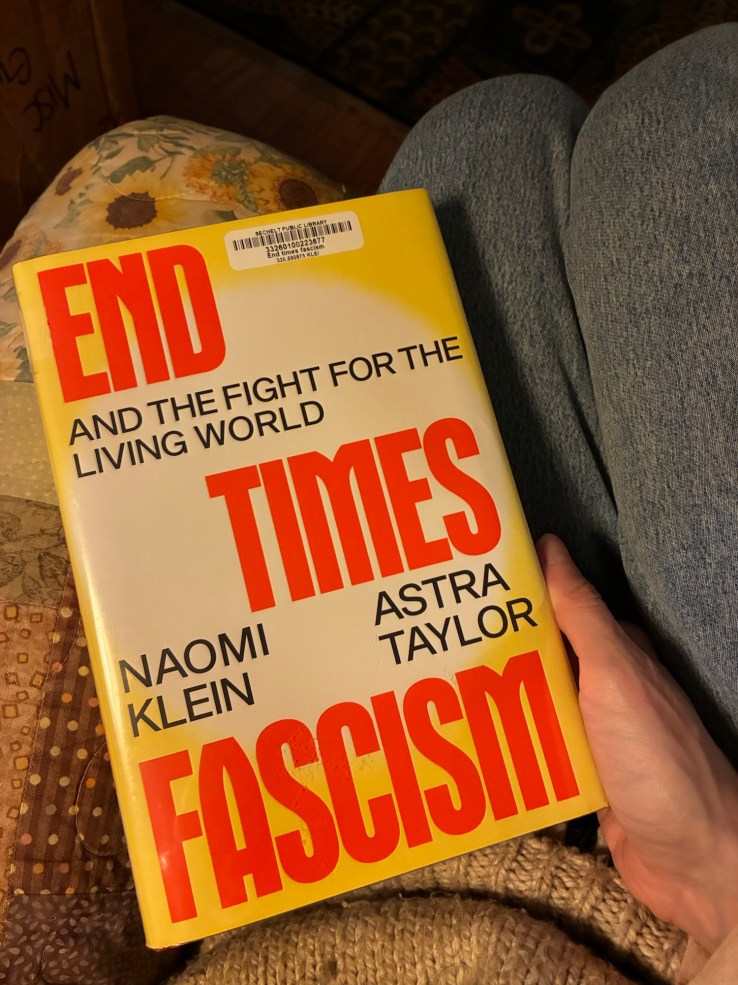
Naomi Klein is someone I have a lot of respect for and whose writing I find to be challenging in its content while readable in its style. I know less about Astra Taylor but I still knew right away that I wanted to read this book when it came out. I mostly read the book in hardcopy form when it came available at the library but I did also have an audio version thanks to Libro.fm and I tuned in that way a couple of times too. (I don’t do as well with non-fiction audiobooks.)
In End Times Fascism, Klein and Taylor tackle our current political, social, and environmental status, worldwide, with a primary focus on the United States as it exists in 2026. In their introduction, they detail some of the ways that fascism can look in the 21st century. Many of us have long associated the term fascism simply with Nazi Germany and here the authors state the danger of that limited view. If fascism only looks one way or occurs under one specific set of circumstances, then we don’t have to worry about it now. This, clearly, is not the case and it’s up to us to be aware of what they have termed “end times fascism”.
End times fascism ties in to a sort of accelerationist belief that the world is going to end anyway so those who can might as well grab as much wealth and power as they are able to while they can. It’s someone like Elon Musk not concerning himself with the political stability of the USA or the safety of its citizens, because he’s planning a colony on Mars. It’s someone like Jeff Bezos or Mark Zuckerberg not worrying about climate change refugees as the planet gets hotter because they both have multiple bunkers somewhere. For end time fascists, it doesn’t matter if the world becomes a cesspool (literally or figuratively) because they are taking care of themselves. The average person doesn’t have the resources of these billionaires and the billionaires are no longer even pretending to care.
Klein and Taylor lay out how these attitudes are affecting politics around the world (what does it do to a nation when their leader cares only about his own benefit?) and how such attitudes have grown and developed. They delve into some of the ways that this belief has overlapped with and even been encouraged by religious groups, often right-wing Christians.
End Times Fascism gets real about AI and data centres and the ways that they are destroying communities, people, and the environment right now. This part was particularly sobering because while I knew a lot of it in the abstract, I actually wasn’t as aware of what is happening in North America right now. I’ve never been a fan of AI and I’ve never used ChatGPT or any of those others but learning more solidified my belief in supporting real human brains.
In this way, there is a lot in this book that is heavy and bleak. We are living in difficult times and there are very real powers that are pushing to make them more difficult. At the same time, there are also many people who desire change and are working and sacrificing for that change. Klein and Taylor interview some of the local residents who are fighting against data centres in their neighbourhoods. They detail the ways that Minneapolis fought back against ICE earlier in 2026. (I was reading this as Americans went to the polls at the beginning of the month and I got teary-eyed seeing footage of people putting their “I Voted” stickers on the telephone poles near the spot where Alex Pretti was murdered.) They talk about ways that politics can change and places where it has. There is a section on Zohran Mamdani’s campaign in New York City and how he pulled off that unexpected victory. The message of End Times Fascism is clear: change is possible but we must act now.
As I said, while the book does reference other countries around the world and their political landscape, it is very USAcentric. Taylor and Klein are both Canadian-American and I would have liked to hear more of their take on our current politics in Canada. (Also while I was reading this, my own province of British Columbia made the unexpected choice to vote in a Conservative government.) At the same time, I’m not surprised. Klein’s husband is Avi Lewis, leader of the federal New Democratic Party in Canada. So I understand why she opted to steer clear of that topic but it does feel like a missing part of the book.
Overall, I think this might be one of the most important books you could read in 2026 and I’m recommending it to anyone who might be remotely interested. (And maybe some who aren’t.)


