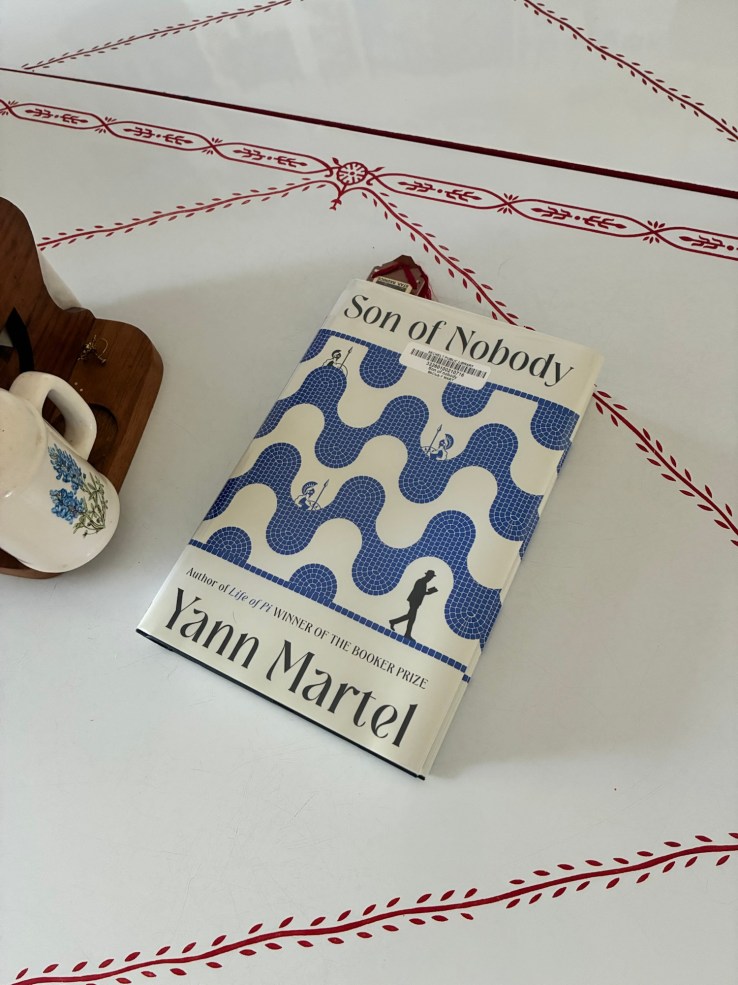
I recall reading an interview with Yann Martel several years ago (which I can’t find online now) where he expressed that he didn’t care if anybody read his books. At the time, I remember feeling annoyed. What privilege to have books published and not care if anybody else reads them! But that interview came back to mind as I read Son of Nobody and this time I thought, how creative he gets to be when he lets go of the expectations of readers.
I actually started listening to Son of Nobody in audio version but quickly realized this was a book that would work better for me on the page. I listened to the introduction and then a library copy came available and I quickly switched. Son of Nobody is a fictional annotation of a fictional work of Ancient Greek poetry. As such, the book is presented with the Greek poetry – known as The Psoad – on the top of the page, accompanied by the main character’s annotations at the bottom of the page. If you’ve ever taken a university literature class, you’ve probably read something in a similar style though you’ll find these footnotes very different.
The Psoad doesn’t exist. Harlow Donne is a scholar of Greek history and epic poetry, a graduate student. When he is given the opportunity to study for a year under an eminent professor at Oxford University, he takes it, even though it means leaving his wife and young daughter, Helen, back in Canada. While at Oxford, Donne comes across what he believes to be a lost epic poem depicting the Trojan War, this time from the perspective of the common soldiers of Ancient Greece, particularly one named Psoas, called the son of nobody.
On the top of the page we are presented with Donne’s translation of this discovered work. On the bottom half are his annotations – some providing context, some comparing to the better known works which depict the Trojan War. Other annotations tell us the personal story of Harlow Donne, how he came to be at Oxford and what happened to his family while he was there. There is often a lot of blank space. The story, as a whole, is light on plot. Not a lot happens to Donne though what he does experience is certainly compelling and there’s a sense of impending doom that kept me reading to find out if he would be okay.
Similarly, the Psoad isn’t exactly a poem driven by a dramatic plot. Most readers will probably be familiar with at least the outline of events surrounding the Trojan War. The interest lies in figuring out the role of this particular nobody. Why focus on him? What will he do? Will he survive?
These two stories, set thousands of years apart, dovetail nicely as Donne’s annotations begin to show us the type of man he is. And underneath this double-layered story is the growing understanding that the character of Donne controls this entire narrative. He’s the one who has discovered the story of Psoas, who has translated it, who has pieced it together. By the end I felt like I was reading a puzzle, like I was trying to put together some lost artifact, enjoying the complexity of the layered stories that Martel has created here. It’s an unconventional approach to a novel but it worked for me and I found myself admiring the guts of a writer who isn’t worrying so much about what the reader might think.


Interesting! Martel never seems to write the same thing twice. Have you read Nabokov’s Pale Fire? Very similar situation with the footnotes becoming more and more clearly the place where the real story is occurring… whatever “real” might turn out to mean.
No, I haven’t but that makes me want to now! I think it’s a clever format.
It is, and really fun to work out as you go along! Another readalike (in this sense at least) is Jordy Rosenberg’s Confessions of the Fox.
An interesting review. I think I will enjoy the unrealiable scholar’s thoughts and all the complexity he is creating, as you put it, but I also have a feeling that people well-versed in Greek myths will enjoy it more? And, speaking of unrealiable narrators, I think Martel, the millionaire, can certainly afford to not care what his reader might think 🙂 And then, that comes from the man who is accused of making his name and fortune through another man’s book? Art mirrors life? I read that he plagiarised the 1981 novella Max and the Cats by Brazilian author Moacyr Scliar to write Life of Pi. Mantel never denied the inspiration (oh yes, he only read the review of the novel not the novel itself!), but since knowing all this I just cannot look at him the same way.
I think you might enjoy this too. It definitely helps to have some familiarity with Greek myth and the story of the Trojan War in particular. The question of influence vs plagiarism is always such a tricky one. I do think Martel is a talented writer but I can also see how that could turn someone off of his work completely.
Have you ever noticed that some of our most beloved authors and actors are not on social media at all? I think that ties into this concept of not caring what people think about your work. When a person puts themselves out there, they let in all the creatures, both fun and dark. I think it’s better just not to. Imagine taking a fiction writing class and having thousands of people give feedback on one story you wrote. You couldn’t do anything with all that anyway.
That is very true. I really respect when people can do that because I find I care very much what others think and have to wilfully ignore that people pleasing part of myself. So go an author to straight up say he doesn’t care…I’m in awe!
[…] Son of Nobody – Yann Martel (Alfred A. Knopf Canada, 2026) […]