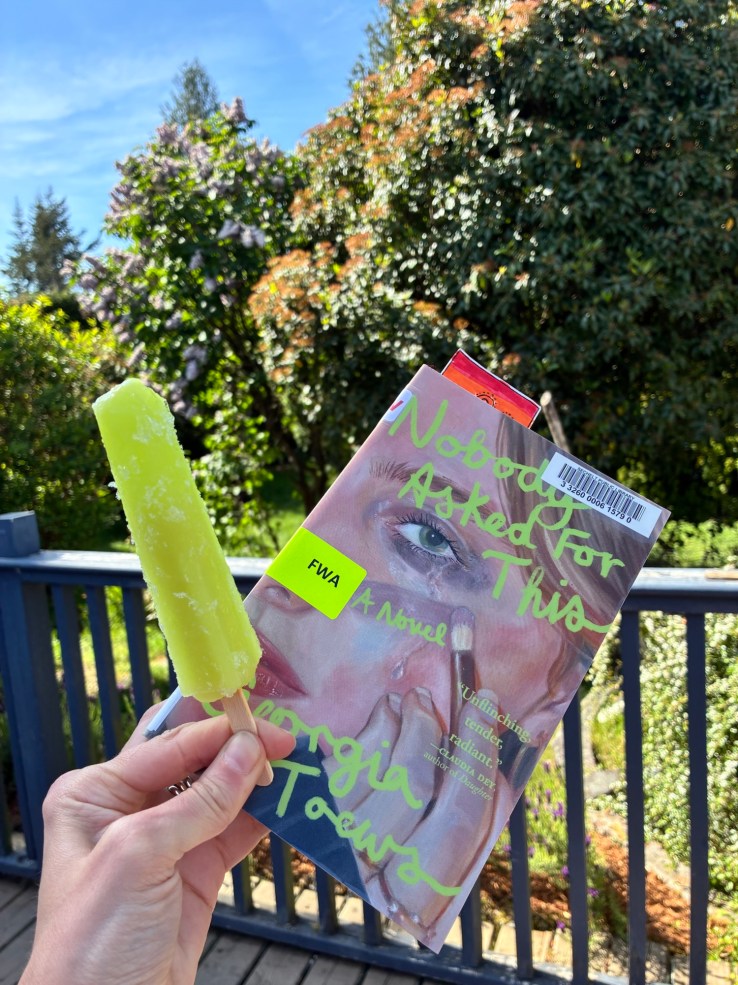
I might not have picked this book up if it weren’t for the fact that Georgia Toews will be one of the featured authors at my local Writers Festival this summer. I’m glad I did though because I found this novel to be a fresh and interesting voice in contemporary fiction. There were definite hints of Sally Rooney here, with a flavour that felt like something different from many of the books about young adults I’ve read recently.
Virginia is 23-years-old, a stand-up comic living and working in Toronto but trying to get her green card so she can move to Los Angeles. She lives with her best friend since high school, Haley, and find herself increasingly maneuvering her life around Haley’s all-consuming depression. Virginia is doing okay – bi-weekly dinners with her stepdad, Dale, and frequent comedy acts in clubs around the city. But life at home with Haley is becoming more and more fraught with tension and then a date with another comedian turns out to be a terrible encounter and Virginia doesn’t know if she can turn her life into comedy or how to move forward.
I can’t think of another book I’ve read where the protagonist is the one dealing with someone else’s overwhelming depression. I can think of plenty of books where the main character is the one deeply depressed and you wonder how their friends manage it or keep showing up. But here we have what I felt was a pretty realistic depiction of trying to maintain a relationship with someone who is depressed for no particular reason. Haley alludes to her trauma but Virginia has known her for long enough to know that nothing really that traumatic has happened to her best friend. And Virginia especially knows this because when they were teenagers, Virginia’s mom got sick and then died and this is something that Virginia is still working out. It’s been years and she is increasingly angry and confused by the fact that she is still so sad. But Haley’s clinical depression – something Virginia knows she can’t control but is frustrated that Haley won’t control – is the overwhelming emotion in their apartment and doesn’t leave enough space for Virginia’s grief over her mother or her hurt and confusion about what happens to her on her date.
Amidst this, her stepfather wants to sell the house she lived in with her mother and her father is getting remarried. It’s a lot for one person to carry and Virginia is trying to figure out if she can make a comedic bit out of it all. Haley is the person who offers continuity from her life with her mother into the life she is currently living.
Readers looking for neat solutions or illuminating conversations won’t find them here. Over and over, Haley and Virginia have conversations that are frustratingly real, neither of them quite saying what they want to. They fight, they fall back into private jokes and histories, they argue and know just how to hurt one another. It’s almost painfully realistic as to what it looks like to move through the end of a friendship. Virginia is trying so hard to support Haley without understanding really what Haley is feeling and nothing anyone can do will change what Haley is going through. They are both good characters and they are both awful in equal turns.
The part I enjoyed less about this novel were the stand-up comedy bits. We get chunks of Virginia’s comic routine, as well as the other comedians she works and interacts with and, well, I just didn’t think they were that funny. I’ll be the first to admit though that my interactions with stand-up comedy are extremely minimal and I don’t in general enjoy the crude type of humour all of the comics in the book seem to employ. So your mileage may vary but I found I couldn’t tell if Virginia was supposed to be successful at what she does or not. She seems to be getting a decent amount of gigs, though not all of them, and I thought she was much funnier in her thoughts than she was on stage.
Overall though, I did enjoy this novel and I would recommend it to readers looking for something slightly different than another “messy woman” book.


Firstly, I cannot believe you found a popsicle that matches the cover of the book, lol. That is really funny that you couldn’t tell if the main character was supposed to be funny or not. Comedy is all about timing, which doesn’t exist in text form unless the author uses ellipses or something like that. I’ truly interested in this book because having an emotional vampire for a friend, whether it’s a mental illness or something that the friend is choosing to wallow in her feelings. Either way, something hard I learned about living with a person who has ADHD is yes, they have a disability, but it’s also abusive for them to claim they are going to continue hurting you because they have chosen to not use any tools (therapy, medication, exercise, sleep, etc.).
Okay, side note: I accidentally added a comment to your other recent book review that I meant to add to this one. The comment was that I checked out reviews of this book on The StoryGraph, and people really did NOT like it. I was wondering if you saw anything that might explain the huge disdain from other readers.
I did not plan the popsicle matching! We have a box of mixed flavours and lots of green left because it’s the least favourite one and as I was going outside to eat my popsicle with the kids, I realized it exactly matched the book I was reading!
This kind of stand-up comedy doesn’t translate well to the page, you’re right. Virginia might be hilarious in person. I kind of liked that I wasn’t sure because it didn’t really matter to the plot. Maybe she’s bad and she won’t be successful. The point is more about her making the attempt.
I thought the portrayal of that kind of emotional vampire relationship was really well done. I had a friend in high school who was really depressed and I cared about her and tried to help her but I didn’t know how and it was really hard. She came to rely on me in weird ways and that made it harder and even her parents relied on me and eventually I had to distance myself and we stopped being friends. I sometimes imagine she tells the story now about her friend who abandoned her in her depression but until she (and her parents) were ready to address the actual illness going on, I was only being hurt by that friendship.
I’ll have to go look at some of those other reviews. Did they also not think the character was very funny? The one thing I can think of is the bad date/ encounter she has with another comedian. I’m not entirely convinced it was necessary and I can definitely see how it could upset readers.
Several people commented that her stand-up comedy was not funny, so you are not alone. I’m not sure; I’ve come to realize that a lot of readers on places like Goodreads and The StoryGraph often miss the subtlties, like of COURSE this is a book about an emotional vampire and not just an “annoying” person.
Yes, I think we’re supposed to be annoyed by Haley but also Toews shows the deep history these two women have and why this friendship matters to Virginia. You can’t just write Haley off as annoying or you’re missing the point of the whole story! I don’t always find reviews on those sites super helpful either but it can be nice to get a sense of what readers in general think of a book.
[…] Nobody Asked for This – Georgia Toews (Anchor Canada, 2026) […]