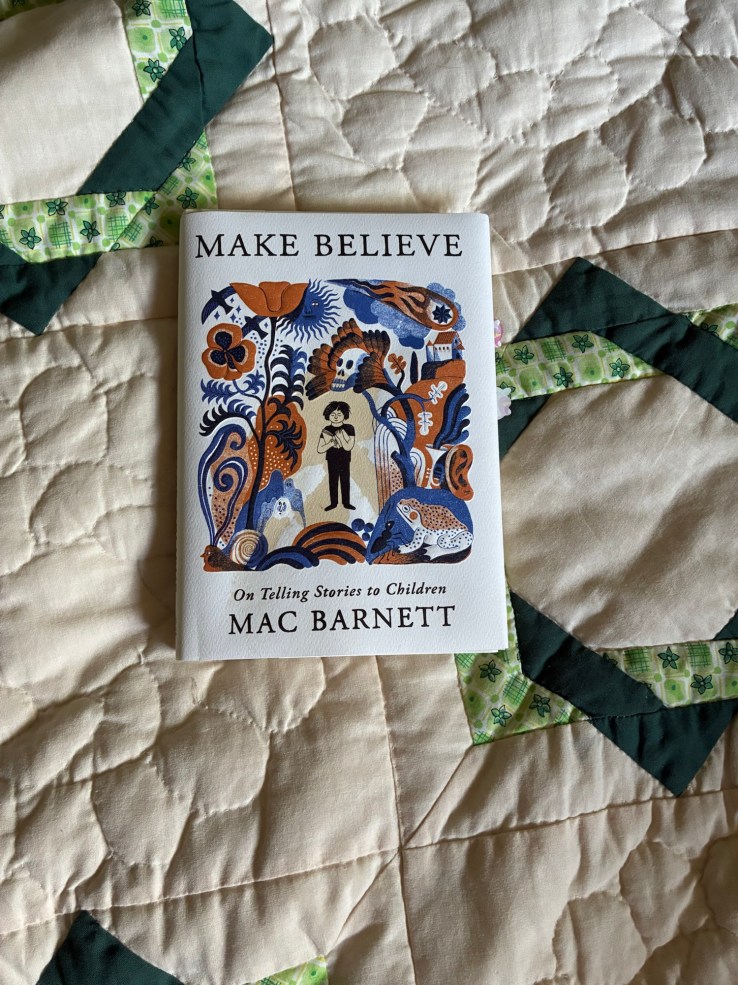
I really like Mac Barnett’s picture books for kids – Sam & Dave Dig a Hole is a favourite – so when I saw that he was coming out with a book about writing stories for children, I was interested. I already had my copy set aside at the store when the book started to garner some controversy. Mac Barnett was being criticized for saying “maybe more like 94.7 percent of kids’ books are crud”. By now this apparently controversial take seems to have faded out of the public discourse and I think it’s because most of us know it’s true. Listen, I work in books, I have kids, and I once was a child. There are a lot of terrible children’s books out there. Just like – and this is part of Barnett’s point if you read the above quote in the context of the book – there are a lot of bad books out there. Especially now, when there are so many ways to publish and be published, there are a lot of books out in the world that are not worth a child’s time. Barnett explores this further to point out that children are a huge audience who do not necessarily have much say in what is published for them. They aren’t (usually) the ones writing kids’ books, they aren’t the ones publishing them, and they (generally) aren’t the ones buying the books. Barnett argues even the fact that we lump all books for kids together as if they are one singular genre makes little sense.
But the big reason for our low opinion of children’s books is simply that lots of children’s books are bad. Anybody who reads regularly to kids knows this. There are so many bad kids’ books, and kids books are bad in so many different ways. There are treacly ones, and preachy ones, and ones that don’t make any sense; books that are supposed to rhyme but don’t; books with amateurish writing, or amateurish illustrations, or both; bland books; boring books.
But I would point out: Lots of adult books are bad, too! Most of them, even.
Adults, however, usually have the advantage of choosing their own books. If we want to read literature, we seek out literature. If we want to read bodice-rippers or horror set in space, we can find that and read it. Children, often, do not have this freedom of choice.
Reading this short book, Barnett’s passion is contagious. He isn’t a children’s book author because he couldn’t hack it in adult fiction, he truly loves what he does and believes in the importance of stories for children. It’s an infectious attitude, not just for writers but for readers. As adults, we may not be the target audience of kids books (and Barnett would argue that we should not be) but we have a lot of power over what kids read. This is a book that I would recommend not just to parents but to bookstore buyers, teachers, and librarians.
(Search my Reading with Pearl & Rose tag to see some of the books I’ve read and loved with my own children.)


I like the acknowledgment that kids’ books aren’t meant for adults. So often I see reviews for children’s movies that are awful, just slaying the movie as being too silly or too wacky, as if that movie was supposed to be something akin to Schindler’s List. On the other hand, some people hit it right in the sweet spot, like the folks who make the trolls movies. There’s no harm in pairing 1970s music with contemporary cartoons; it makes things fun for both the grandkids and the grandparents, or people like me, who have no kids and still remember that music playing when I was little.