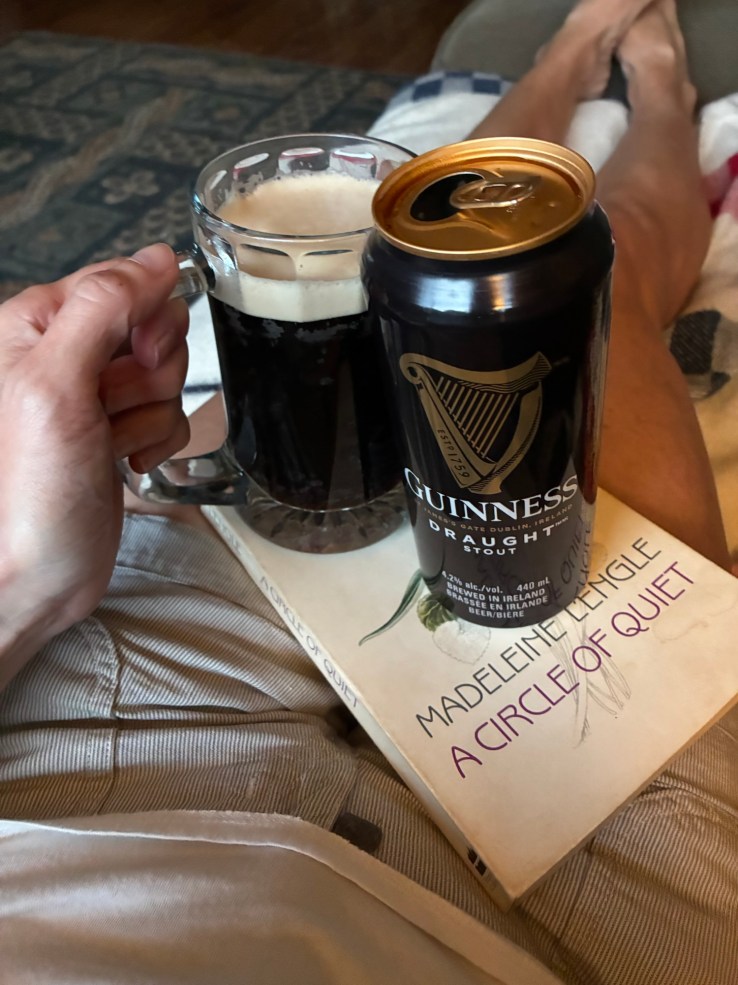
It’s hard to know how to classify this gentle non-fiction book. It’s part collection of essays, part journal entries. It’s the thoughts and pondering of a 50-something year-old-woman, a wife and mother, who has had some success as a writer. There is some space given to her own history but it’s not a biography. There are thoughts on living in community, on pushing through the years of unsuccess as a writer, on believing in God. It’s a jumble of ideas that don’t feel jumbled.
I was introduced to Madeleine L’Engle at a young age through her children’s books, starting with A Wrinkle in Time. Of that series I best liked the strange time travel of A Swiftly Tilting Planet. I read several of her books about the Austin family, though mostly out of order. I never knew much about her as a person. At some point in the late 1990s I recall becoming aware of her as a person of controversy within Christian circles. Some of her ideas about God and faith were less than orthodox and apparently it was a matter of debate among Christians whether or not L’Engle truly was a Christian. I remember being confused by this but continuing to enjoy her books, including a re-read of A Wrinkle of Time in class when I was attending a Christian school.
Many people who have rejected the church today have done so because the establishment which calls itself Christian so often behaves in an unchristian manner; because, in the name of Christ, we have so often been intolerably cruel to other human beings.
Now, as an adult in 2026, reading Madeleine L’Engle’s thoughts in her own words, the entire argument seems rather quaint. Did I agree 100% with everything L’Engle had to say about God and faith? No. But I agreed with a lot of it and I think if I ever sat down with her over a drink, maybe by a fire, we would find ourselves kindred spirits. In fact, I believe that perhaps one eternal day in Heaven, we might just have the opportunity to do so.
I was surprised by how much of her pondering from the 1970s felt relevant to today. When L’Engle worries about the world her children are inheriting and the discontent she sees growing among their generation, I recognized some of my very own parenting anxieties. When she talks about marriage and the ways two people can grow and change together, that too felt familiar.
I particularly enjoyed her musings on writing and writing for children. Having recently read Mac Barnett’s Make Believe which is exactly about this subject, I felt like L’Engle and Barnett were very much on the same page. It’s funny that Barnett’s opinions met with so much backlash and I wonder how L’Engle’s opinions were received at the time.
If it’s not good enough for adults, it’s not good enough for children. If a book that is going to be marketed for children does not interest me, a grownup, then I am dishonouring the children for whom the book is intended, and I am dishonouring books. And words.
I think I understood this as a child and even when I wouldn’t have ranked Madeleine L’Engle’s books amongst my very favourite, I knew that this was an author who respected me as a reader, whether I was 8-years-old or 28. I still felt that now, at 40.


[…] A Circle of Quiet – Madeleine L’Engle (Harper Collins, 1972) […]