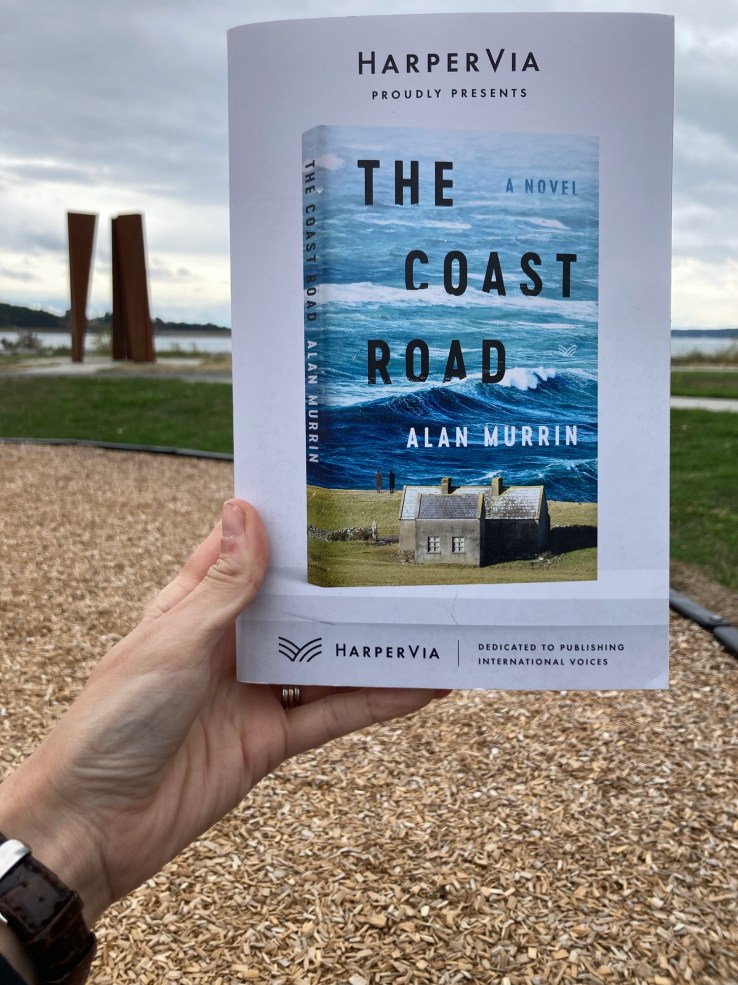
I received an Advance Readers Copy of this book from the publisher. All opinions are my own. Book is on sale now.
Without quite intending to, I’ve found myself reading quite a bit of Irish writing this past year or so. I don’t know if I can be so bold as to say that I’m familiar now with Irish culture and sensibilities but there is a rhythm to a lot of Irish writing that I really like. And there is, maybe, an underdog feeling to many Irish settings in characters that I appreciate. Perhaps it’s the Canadian in me, living as we do under the shadow of our American neighbours!
The Coast Road is set in 1994 in a small town in Ireland, focusing primarily on two women. Izzy Keaveney is a housewife, married to a local politician. Izzy and James have a volatile relationship, marked by long periods of silence between them, but they maintain an outer demeanour of traditional man and housewife. Colette Crowley is more outwardly different from the housewifes of their community. A poet and a woman not born and raised in the town, six months ago she left her husband and sons to be with another man. Now she has returned to County Donegal but her husband bars her from seeing her sons. Colette enlists Izzy to enable her to see her boys.
The whole story takes place over a few weeks, leading up to a referendum in which the people of Ireland voted on whether or not to allow divorce. While none of the characters (including the local priest) seem particularly devout to me, religion and Catholicism permeate the story and these people’s lives. Divorce has a heavy cost in this community, both socially and spiritually.
Murrin handles the various perspectives deftly, showing us carefully and subtly the various marriages that exist in such a time and place when there is no other option. There is sometimes a separation but even those couples are bound together until one of them dies. By the end of the book, I realized that the perspectives we see are primarily all women, a choice that surprised me in a book written by a man. Murrin seems to carefully leave the perspective of married men (we get a little bit of the priest’s perspective) to the side. Even as late as 1994, the men hold most of the power and so, here, Murrin shines a spotlight away from them and onto the women. I found myself frequently forgetting that this was a story set within my own lifetime because there was such a heavy old-fashionedness to the setting and characters.
I’ll look for more work from Murrin in the future.


Ireland always strikes me as a fun-loving country. Good times all around. I forget how oppressed and tight they were for a long time, much of which seems to be English influence on the culture. No divorce, oppressive religion, the way children were treated in school, etc. Divorce only became legal in 1996.
Ireland as a country seems to different from the Irish people themselves. I knew in a vague way that it had a restrictive history but seeing that date of 1996 really brought it home.
I remember taking a British Lit class in which we read some fairly dark books set in Ireland in the 1990s. It home for the class because at the time we were all old enough to remember the 90s.
Yes, learning about the Magdalen homes etc was somewhat similar to learning about residential schools in that it was shocking to realize these things existed in such recent history.
Gosh I’m shocked Divorce was illegal for so long in that country – who knew? that’s crazy
I was really surprised! I figured it was still heavily frowned upon but didn’t realize legalization had occurred within my own lifetime!
I find novels that look at communities that seem highly religious, but no-one is actually devout, fascinating if sad to read about. Did you feel that the book got into that, or is it just kind of there in the background?
It didn’t really delve into the religious background of the culture. It was assumed that the reader can make the question between the Catholic Church and the fact that divorce is illegal. But none of the characters seem for or against divorce from a religious perspective.
[…] The Coast Road – Alan Murrin […]
[…] The Coast Road – Alan Murrin (Harper Via, 2024) […]