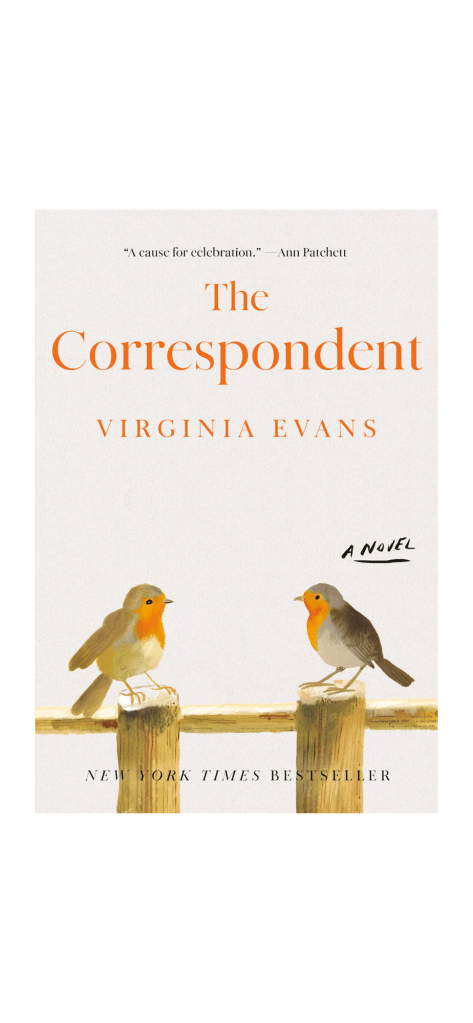
This book has been getting a lot of hype amidst the circles that I run in. While I wasn’t initially that drawn to the concept, my curiousity grew as people kept raving about it. When The Correspondent made it to the Women’s Fiction Prize shortlist, I put my name on the long list at the library. I ended up getting a copy as a quick read option (one week only), which was just fine because I read it over a weekend.
This is a story told in letters, primarily written by Sybil van Antwerp. Sybil is retired and divorced. She had a successful career in law and has two adult children, neither of which she is close with. She lives alone and fills a lot of her time with writing letters. She writes to authors (Joan Didion, Ann Patchett, Larry McMurtry. She writes to editors, to her lifelong penpal and former sister-in-law, to the teenage son of a former colleague. Sometimes she writes e-mails but she prefers paper and pen. She is meticulous and set in her ways but Evans doesn’t take this to the quirky levels we see in books like The Rosie Project or Lessons in Chemistry. Sybil is smart and likes things done a certain way but she isn’t functioning on the edges of society and, as her letters show, she’s more than capable of creating and maintaining relationships.
We follow Sybil over several years of her life as she moves further into her 70s. We learn that she had a third child who died when he was young and that following this tragedy, her marriage slowly fell apart and that when her husband returned to his native Holland, their daughter went with him. We learn that Sybil was adopted as a toddler and when her son gifts her a DNA test to learn more about her ancestry she is initially upset and completely against taking such a test. Though when she does, she strikes up an email correspondence with an employee of the company. After the death of her closest former colleague, she begins to receive threatening notes related to a legal case from long ago.
The tensions of the novel are small but life-like. What will Sybil do with the information the DNA test provides? Will her relationship with her daughter ever change? What does her decreasing eyesight mean for her future? For her correspondence?
Looking back at this book, I have mixed feelings. I enjoyed it while I read it and I found it easy and compelling to read. But it also isn’t a book I’ve given a lot of thought to afterward. It’s a very introspective novel and it’s largely about a woman who is coming to terms that she is entering the last section of her life. I think it’s great to see more of these types of perspectives in popular fiction. At the same time, I felt like Sybil was almost the opposite of me in every way. For me, as a reader, there weren’t a lot of surprises in the story. There are segments of unsent letters scattered throughout the book, their recipient not named until the end. But, to me, it was very clear almost from the first who these letters were intended for so I wasn’t sure if there was supposed to be much pay-off when that was confirmed at the end.
Overall, this was a satisfying and easy-to-recommend read but I don’t know what I’ll recall from it by the end of 2026.


Recently, I’ve been rethinking how I write my reviews. While I was working one day, I grabbed a sticky note and write down, “Why they should read it, why they shouldn’t read it, why they should be exposed to it.” Your review sounds a lot like that last one. While there isn’t much reason to read the book, you recommend our exposure to it. I was thinking about my reviewing style because I noticed that in my reviews I wanted to mention EVERYTHING I liked or disliked about the book, so my reviews seemed long and muddled as to whether I thought you all should read the book or not. Taking a more simplistic approach helped me write some stronger reviews yesterday.
I like that! It can be tempting to just sort of word vomit all your feelings about a book but honing that into the WHY of whether or not a reader should choose a book could make for a stronger review. I do like knowing about the things that made someone else like or dislike a book. Sometimes I have decided to read a book a reviewer disliked because I can tell the things they disliked won’t bother me.
Absolutely–when someone writes that the book was too creepy, or too much into the weeds about volcanos, I’m like, “Sign me up!” But what’s happening with me is I sound on the fence because I see too much when I’m reading, which likely stems from my days as a professor reading works to look for themes and discussion topics, not reviews.
Ok, that makes sense! I feel that way a little bit as a leftover of literature and writing courses in university, though that was now many years ago for me. Nowadays, my book discussions are often with customers so it’s whether or not this is worth your time to read/spend your money on.
Oooh, fieldwork for the blog.
😂
I really enjoyed this book, and I totally agree that it’s nice to see these perspectives increasing in popular literature. And what a good sign it was a bestseller, clearly there is a market for it! What I recall most about this book was Sybil’s personality. I loved how sassy she was.
I liked that Sybil was clearly an older woman and that was an important part of her perspective but it also wasn’t her defining characteristic. You could imagine her at different stages of life because she felt like a fully-fleshed human.