The term “astronaut family” was coined in 1999 and I suppose that’s around the time when I would have heard it first also. But by then it was already a concept I was familiar with. This was a term used to describe families where one or more of the members lived in a different country. I typically heard it used in relation to fathers. I can think of a few families I knew who had immigrated to Canada from somewhere in Asia, settled the wives/mothers and children down, and then the father went back and forth between Canada and (usually) Hong Kong or Taiwan.
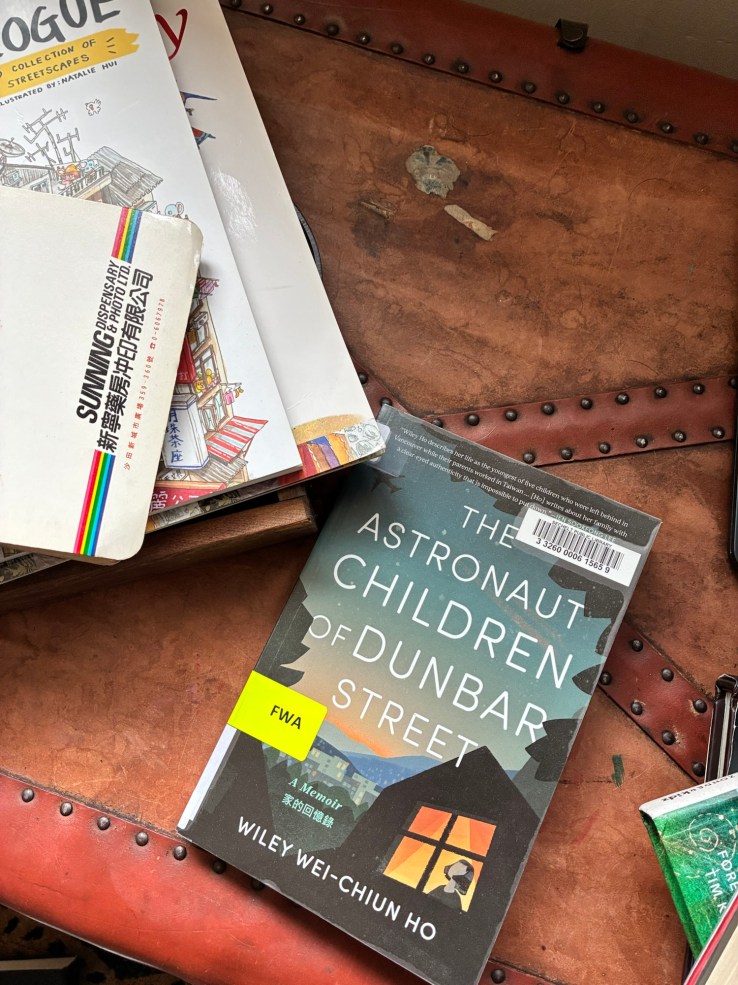
Wiley Wei-Chiun Ho’s family immigrated from Taiwan to Vancouver in the late 1970s, largely in order to keep her oldest brother from being conscripted into the army, due to their father’s own military experiences. They settled first in Kerrisdale and then in Dunbar, struggling to adjust to an entirely different language, culture, and system. Ho, the youngest of five children, was seven years old when they arrived. After several years in which her parents struggled to find work, her mother and father made the decision to return to Taiwan and leave their children in Vancouver. Ho’s oldest sibling, her brother, was 18 while she was 12, three sisters in between.
This is an honest and intimate look from Ho at her childhood and her family. She writes it with the framework of returning to Taiwan as an adult, rushing to visit her father at the end of his life, while having to comply with the strict quarantine rules of Taiwan in 2021. She takes us back to her early memories of life in Taiwan. There her father was a doctor and her parents owned and managed a private hospital. Her family had prestige and connections, living in a large, extended family unit. But the uncertainty of Taiwan’s future led them to Canada. There, her parents struggled with their place in a new country. Their return to Taiwan is both financially and socially driven. Ho, as the youngest in her family, has the loosest ties to Taiwan and even when her older sisters eventually choose to return to Taiwan as adults, Ho opts to stay.
The author takes us through the breaking apart of the family after her parents leave. Visits and even phone calls are expensive and thus rare. Her brother, under immense pressure to follow in his father’s medical footsteps, is ostensibly in charge but ill-equipped to care for 4 teenage girls. The sibling relationships fracture as they each retreat into their own separate world. Ho must carefully manage her family’s status in her public-facing life, not letting teachers or coaches know that she no longer lives with her parents.
Ho tells her story well. She’s brutally honest about her own struggles and shortcomings, including her battle with an eating disorder, and her uncertainty around her own identity. Is she Canadian? Is she Taiwanese? What does being Taiwanese even mean when Taiwan is often not recognized? She lives under the shadow of her parents’ sacrifices for her but she herself is something that they sacrificed along the way. The older she gets and the longer they live apart, the harder it becomes to repair or change their relationship and we watch that play out.
Ho is going to be one of the featured authors at this year’s Sunshine Coast Festival of the Written Arts and I’m looking forward to hearing her speak further on this powerful debut.


This sounds fascinating, but I must admit, I’ve never heard of the term astronaut family!
I don’t know that it’s a term used that widely but I have heard it before in this sort of family context. The author who coined it works in California so it’s at least a west coast term!
I’m confused because it sounds like the family were prosperous in Taiwan and then moved to Vancouver to help the oldest son avoid the draft. Why not just send the oldest son to Canada, a son who is already an adult? I mean….they disrupted the whole family? This was a truly wild decision to me. Wow. I hope the event at which the author appears is more illuminating. Now I’m curious and want to check if my library has this book. I’d never heard of an astronaut family before this post, and I’m wondering if you’re more aware because your parents were (are?) missionaries.
You know, I didn’t think of that while I was reading. They even already had an uncle who lived in Vancouver so they could have sent the brother to him. Though she does mention at one point that he can still be drafted until he’s in his 30s or 40s (I forget) so her brother basically never returns to Taiwan. That would be hard – to send your child across the world knowing they couldn’t return. It would feel like choosing some of your children over the other.
I don’t think it’s a super widely used term – Anne had never heard it before either which makes me wonder if it’s a more West Coast terminology? I don’t remember when I first heard it but I know it immediately made sense to me and I could think of examples from kids I knew at school. So I think a combo of my parents’ work and the area I grew up in.
[…] The Astronaut Children of Dunbar Street – Wiley Wei-Chiun Ho (Douglas & MacIntyre, 2026) […]