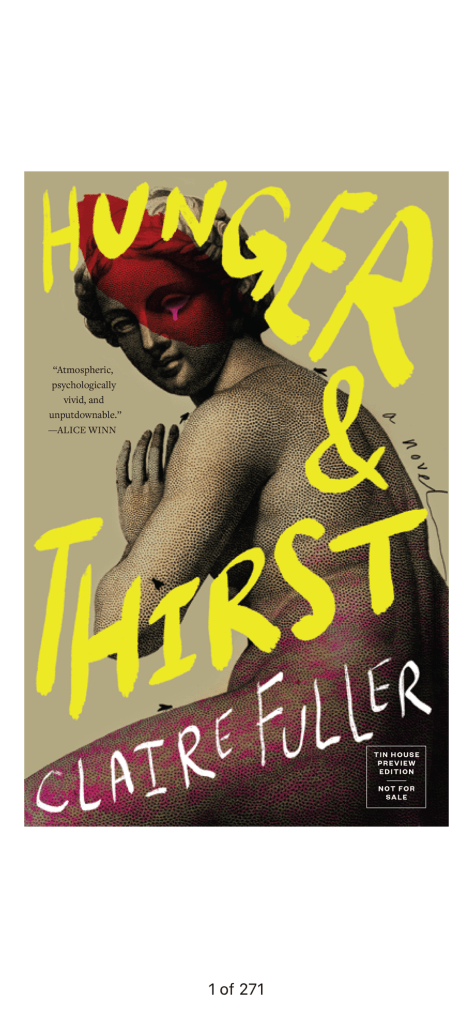
I received an Advance Readers Copy of this book thanks to the publisher and NetGalley. All opinions are my own. Publication date: June 2, 2026
I’ve read several of Claire Fuller’s previous books (see some of my reviews here) and obviously keep reading her because I enjoy her work. There are recurring themes of isolation, complex family relationships, and disease. Hand-in-hand with the isolation of characters is the physical environment in which they surround themselves and this is often very rooted in nature and the animalesque. Fuller excels at these descriptions and always brings a lot of tactile and visceral details into her writing. Hunger & Thirst definitely has these elements and exhibits more of Fuller’s strong voice and character-building.
Here Fuller takes a shift in tone and genre and leans more fully into the horror that her previous books have only hinted at. The Memory of Animals, dealing with the aftermath of a pandemic, gets perhaps the closest to horror, though Fuller’s other books definitely have a focus of the horror humans can inflict on one another and on the natural world. Here, though, she leans fully in. Not being a reader drawn to horror stories, I realize I would not have read this book if Fuller’s name were not attached. (I also didn’t quite realize what I was getting myself into.) I’m not overly familiar with horror tropes but I did recognize some familiar ones – a possibly haunted house, a possession, rotting smells and flies hovering. At the same time, Fuller roots this horror in the reality of childhood and psychological trauma so we’re left to wonder what we’re actually seeing.
In 1987, Ursula was 16-years-old. She’s recently begun a job at an art school and made a new friend, Sue. Ursula has lived most of her live in foster care, moving from home to home and is now working to become more independent. She has a lot of trauma in her personal history and not a lot of support. Sue has a complicated family who are generally supportive of her and she has big dreams of moving to America and making films. It is Sue who suggests that Ursula move into an abandoned house with Vince, a volatile co-worker and Sue’s sometimes boyfriend. Ursula and Vince move into this squat, living amongst the abandoned belongings of a family who might have met a grisly end.
In the present day, we know that Ursula has become a successful and reclusive sculptor. And we know that she is being pursued to be a part of a documentary about something dark that occurred back in 1987.
The book doesn’t turn into full-blown horror until well into the story but Fuller definitely lays the groundwork of the unsettling. Ursula is a strange young woman, struggling to fit in to her surroundings. We learn more about her early years spent with her mother and the trauma she carries from that time. She’s volatile and unpredictable but it’s also easy to be sympathetic to someone so young, unsure, and alone. It makes sense that she clings to Sue who is volatile and unpredictable in her own way. The abandoned house that Vince and Ursula move into is increasingly unsettling as Ursula lives amongst the remnants of someone else’s life.
As the horror ramps up, Fuller keeps reminding us that Ursula may not be seeing things as they truly are. And this is another kind of horror – can we trust our own memories? Is Ursula a victim of circumstances or is she herself the danger?
I don’t know if I’ll keep reading Fuller’s work if she leans harder in this direction but I was glad for the opportunity to read this one and I’ll be thinking about it for a while.


I wonder if leaning into horror as a genre is a direct reflection of how hard we are leaning into true horror in real life today. People losing support systems in republican states, two world wars, abusing undocumented immigrants (not to mention documented immigrants and US citizens), the US president attached closely to a known pedophile and sexual trafficker (and now discussing letting Epstein’s co-conspirator out of jail), etc.
That’s an interesting connection. Fuller’s last novel was about a pandemic (and came out in 2023) so she’s definitely an author thinking about current events. An interesting aspect of this novel is that we are left unsure whether all the events occur as Ursula tells us or if this is some sort of way in which she is dealing with trauma. Making overt and supernatural trauma in order to deal with the more “ordinary” trauma of her life. Which maybe is what the author is doing through fiction here? (I’m remembering now that she’s UK-based so not sure whether that makes a difference either.)
I remember asking Anansi to send me this book, and I thought I hadn’t gotten it yet, but then I checked my bookshelf and it’s there, just with a different cover (pink and black!) so this review has piqued my interest again! I do like horror, and I LOVE Claire Fuller, so I’m excited about this one. It will be interesting to see if she continues in this direction, although I’m guessing she will stay with more literary fiction than falling into a genre.
[…] Hunger & Thirst – Claire Fuller (Tin House, 2026) […]