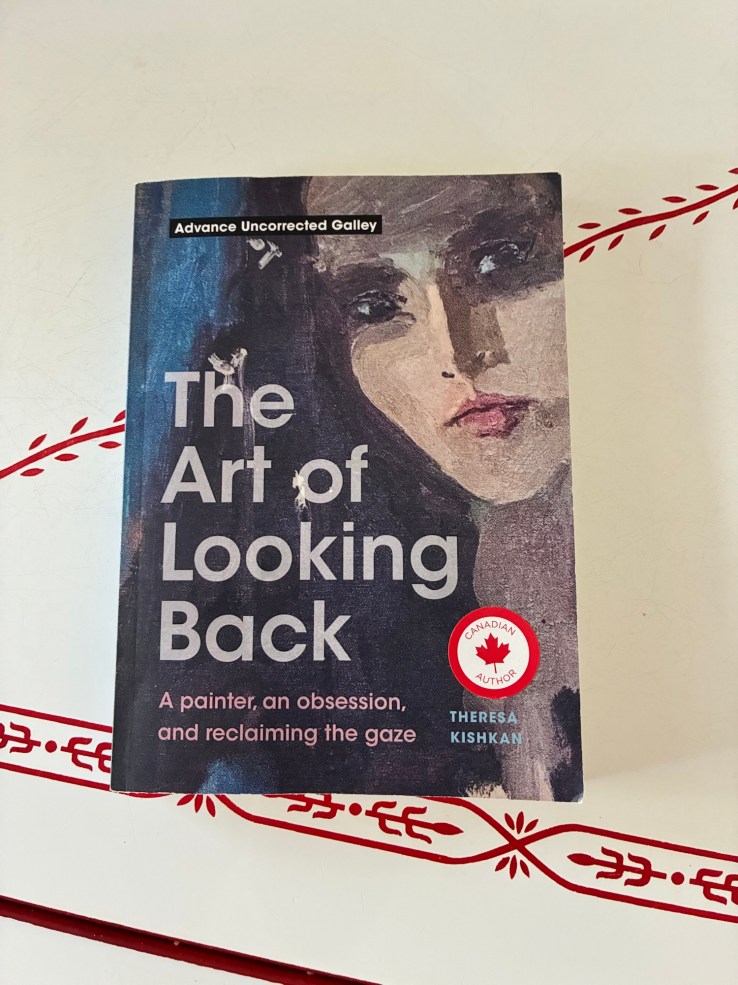
It’s hard to know how to classify a book like this. A retrospective, part memoir, something of poetry, a statement on what it is to be a woman and look back at your life. It’s a work that could really only come from an artist like Theresa Kishkan. I picked up this book because Kishkan lives here on the Sunshine Coast and I know a little of her poetry. I was intrigued by the concept of this book. In it, Kishkan examines a relationship she had with a painter when she was in her early 20s.
Relationship isn’t quite the right word to use though. Theresa is at the very beginning of her adulthood, living in Victoria, planning the next grand adventures of her life.. She meets a painter, a man named Jack Wilkinson, at a party. Afterward he writes her a letter, says he must meet her. She goes to his house to meet him, she is interested by him and flattered by his attention. He is much older – her father’s age – married, with children. They spend some time together and Wilkinson inundates her with drawings, writings, letters. He is obsessed with her and Theresa doesn’t know how to react to this attention.
Wilkinson draws and paints her more than once and becomes a figure that comes in and out of her life for many years after, even after she marries and has children. He gifts her a painting of herself that hangs in her home. Throughout the book, Theresa studies this painting in her own home, examining this younger version of herself, questioning what happened to her years before.
This is a very introspective book. It’s light on action or drama but Kishkan excels at evoking a deep sense of discomfort throughout. Wilkinson isn’t dangerous but his reactions to Theresa are inappropriate and continuously boundary-pushing. Kishkan, looking back years later, can see the situation with a clarity that she couldn’t possibly have had at the time, even as she still feels confused by what it all meant.
I imagine there are readers who may wonder why Theresa goes along with so much. Why she allows this older, married man to monopolize her, why she doesn’t simply brush him off and carry on with her life? But I found her very easy to sympathize with. While I’ve never been in such a situation, I could understand the flattery that such attention might make a young woman feel. I could understand the confusion, the uncertainty about whether or not that boundary had been crossed. Sometimes in your youth you don’t know that someone older (a “real” grownup”) is being inappropriate until you one day reach that age and get to see that memory from the other side. This is something Kishkan really captures. The perspective of a woman with more years looking back at her own self, trying to see the picture – the painting – more clearly.


Maybe the connection my mind made is incorrect, but I thought of the relationship between Frida Kahlo and Diego Rivera. They were passionate lovers who separated frequently, and he was married while she was bisexual and had other male and female lovers. They spent a lot of time together, too. The passionate clash of two adults who seem like they don’t belong together for any number of reasons is fascinating because it’s both representative of so many non-famous, super normal people and also seems rare.
I could see that connection – two artists who are drawn together. Here, the passion is a lot more one-sided than I imagine Frida and Diego were. Theresa is flattered by Jack’s attention but also uncomfortable and unsure of how to handle it. She seems to inspire him but she never tells us that he or his work inspired her.
This sounds really interesting – I imagine I would find it deeply unsettling to have a painting associated with such a strange time in my life hung up in my home, constantly reminding myself of who I was.
Yes, I would too! I wish the author had delved a little more into why she kept it hanging in her house or if she ever thought of taking it down or moving it. She spends a lot of the time in the book looking at the painting but I don’t think I would want such a thing in such a prominent space in my home!
I know exactly what you mean when you talk about a young woman not understanding a boundary has been crossed until they reach that age themselves – this is so true! She clearly feels weird about it, but can’t quite pinpoint why, until she reaches that age herself. This is very common. Age can be a real division, for good reason.
At 14 I was asked out on a date by a stranger on a public bus. He told me he was 25 and that “age was just a number” – ew, right? I knew it was weird at 14 but I distinctly remember looking back once I was 25 and realizing just how weird it was to pursue a 14-year-old. Sometimes you can’t see things clearly until you’re on the other side.
ew is right, just reading this made me feel so icky. I’m sorry you had to experience that, how awful
[…] invite you to come to talk about your book, that one of the friendly women working in the bookstore reviews your book on her blog, and that when you encounter a friend in a clothing shop, the saleswoman […]